Mock Theory Test: Twist Question Edition
(with answers & explanations under each question)
1. Alertness
You’re about to join a dual carriageway from a slip road. Your mirrors are slightly blurred with rain. What should you do before moving out?
a) Move out quickly before traffic builds up
b) Look over your shoulder to check it’s safe
c) Flash your lights to warn approaching drivers
d) Stay on the slip road until the rain clears
Answer: b) Look over your shoulder to check it’s safe ✅
Explanation: If mirrors are obscured, always check your blind spot with a quick sideways glance before joining faster traffic.
2. Attitude
Another driver cuts in sharply and then gestures aggressively at you. What should you do?
a) Sound your horn and gesture back
b) Brake suddenly to teach them a lesson
c) Stay calm and keep a safe distance
d) Flash your headlights repeatedly
Answer: c) Stay calm and keep a safe distance ✅
Explanation: Retaliating increases risk. Staying calm and creating space is the safest option.
3. Safety & Your Vehicle
You’re parked at night on a road with a 40mph speed limit. What lights must you leave on?
a) No lights at all
b) Sidelights only
c) Hazard warning lights
d) Headlights on dipped beam
Answer: b) Sidelights only ✅
Explanation: On roads with speed limits above 30mph, sidelights must be used to keep your vehicle visible when parked at night.
4. Safety Margins
Carrying a heavy load will usually:
a) Improve fuel economy
b) Increase stopping distance
c) Improve braking efficiency
d) Reduce stopping distance
Answer: b) Increase stopping distance ✅
Explanation: A heavier vehicle has more momentum and takes longer to stop safely.
5. Hazard Awareness
You’re driving past a parked ice cream van with children nearby. What should you do?
a) Sound your horn as a warning
b) Slow down and be prepared to stop
c) Continue at the same speed to clear the area quickly
d) Flash your lights to warn children not to cross
Answer: b) Slow down and be prepared to stop ✅
Explanation: Children may suddenly run into the road. Reducing speed gives you more time to react.
6. Vulnerable Road Users
A horse rider signals with their right arm while riding on a rural road. What should you do?
a) Overtake quickly before they turn
b) Slow down and give them space
c) Sound your horn to warn them
d) Rev your engine so they know you’re there
Answer: b) Slow down and give them space ✅
Explanation: Horses can be startled easily. Slow down, hold back, and pass carefully when safe.
7. Other Types of Vehicle
A bus is signalling right to pull out from a bus stop. The road ahead is clear. What should you do?
a) Slow down and allow the bus to move out
b) Accelerate quickly past before it pulls away
c) Ignore the signal – buses must wait for you
d) Overtake on the left-hand side
Answer: a) Slow down and allow the bus to move out ✅
Explanation: Large vehicles need cooperation. Give way to buses pulling out if safe.
8. Vehicle Handling
After driving through deep water, your brakes feel weak. What should you do?
a) Accelerate hard to dry them quickly
b) Drive slowly while gently applying the brakes
c) Stop and call for roadside assistance
d) Pump the handbrake sharply while moving
Answer: b) Drive slowly while gently applying the brakes ✅
Explanation: Light pressure helps dry brakes and restore effectiveness.
9. Motorway Rules
You realise too late that you’re in the right-hand lane as your motorway exit approaches. What should you do?
a) Cross over quickly even if you cut across traffic
b) Stop on the hard shoulder and reverse
c) Continue to the next exit
d) Signal left and expect others to let you through
Answer: c) Continue to the next exit ✅
Explanation: Never stop, reverse, or swerve. Safely continue and exit later.
10. Rules of the Road
You stop briefly on double yellow lines to let a passenger out. Is this permitted?
a) Yes, at any time
b) No, not at any time
c) Yes, but only to pick up passengers
d) Yes, but not to load goods
Answer: b) No, not at any time ✅
Explanation: Double yellow lines mean no waiting. Dropping off or picking up is not allowed unless signs state otherwise.
11. Road & Traffic Signs
You see a red circular sign showing a car and motorbike. What does it mean?
a) No motor vehicles allowed
b) Cars and motorcycles only
c) No overtaking by cars or motorcycles
d) End of restriction for cars and motorcycles
Answer: a) No motor vehicles allowed ✅
Explanation: Red circular signs give prohibitions. This bans cars and motorcycles beyond that point.
12. Essential Documents
Your insurance only covers third-party risk. What does this mean if you cause a collision?
a) Your car repairs will be paid for
b) The other person’s damage is covered, but not yours
c) Both vehicles will be covered
d) No one is covered unless it’s not your fault
Answer: b) The other person’s damage is covered, but not yours ✅
Explanation: Third-party insurance protects others but does not cover your own losses.
13. Incidents, Accidents & Emergencies
You break down in a tunnel and your car won’t restart. What should you do first?
a) Stay in the car with your seatbelt fastened
b) Put your hazard lights on and stay where you are
c) Switch on hazard lights, then leave the car to a safe place
d) Try to push the car to the nearest exit
Answer: c) Switch on hazard lights, then leave the car to a safe place ✅
Explanation: In a tunnel, get out safely and wait in a refuge or safe area.
14. Vehicle Loading
You’ve fitted a roof rack and loaded it heavily. How might this affect your driving?
a) It will improve braking stability
b) It may reduce fuel consumption
c) It will increase wind resistance and affect handling
d) It will lower the vehicle’s centre of gravity
Answer: c) It will increase wind resistance and affect handling ✅
Explanation: Roof loads raise the centre of gravity and make handling less stable.
15. Alertness
You feel very tired on a long motorway journey. What’s the best thing to do?
a) Open the windows wide and keep going
b) Stop at the next safe place and rest
c) Drink strong coffee and continue driving
d) Drive faster to finish the journey quickly
Answer: b) Stop at the next safe place and rest ✅
Explanation: The only safe cure for tiredness is stopping and resting.
16. Attitude
You’re in a long queue of traffic. Another driver is trying to merge from a side road. What should you do?
a) Ignore them – you have priority
b) Move forward to close the gap
c) Allow them to join when safe
d) Sound your horn to warn them not to push in
Answer: c) Allow them to join when safe ✅
Explanation: Courtesy and cooperation improve road safety.
17. Safety & Your Vehicle
What effect could under-inflated tyres have on your car?
a) Improved braking performance
b) Increased fuel consumption
c) Reduced steering response
d) Both b and c
Answer: d) Both b and c ✅
Explanation: Low tyre pressure makes steering less precise and wastes fuel.
18. Hazard Awareness
You’re approaching a junction and your view is partly blocked by high hedges. What should you do?
a) Move out quickly to get a better view
b) Approach slowly and be prepared to stop
c) Sound your horn to warn others
d) Flash your lights before emerging
Answer: b) Approach slowly and be prepared to stop ✅
Explanation: With limited visibility, creep and stop if necessary until the way is clear.
19. Motorway Rules
You’re driving on a smart motorway and see a red X displayed above your lane. What must you do?
a) Continue in that lane if no traffic is present
b) Move to another lane as soon as possible
c) Stop immediately in that lane
d) Use the hard shoulder instead
Answer: b) Move to another lane as soon as possible ✅
Explanation: A red X means the lane is closed. You must not drive in it.
20. Road & Traffic Signs
You see this sign: with a picture of a tram. What does it mean?
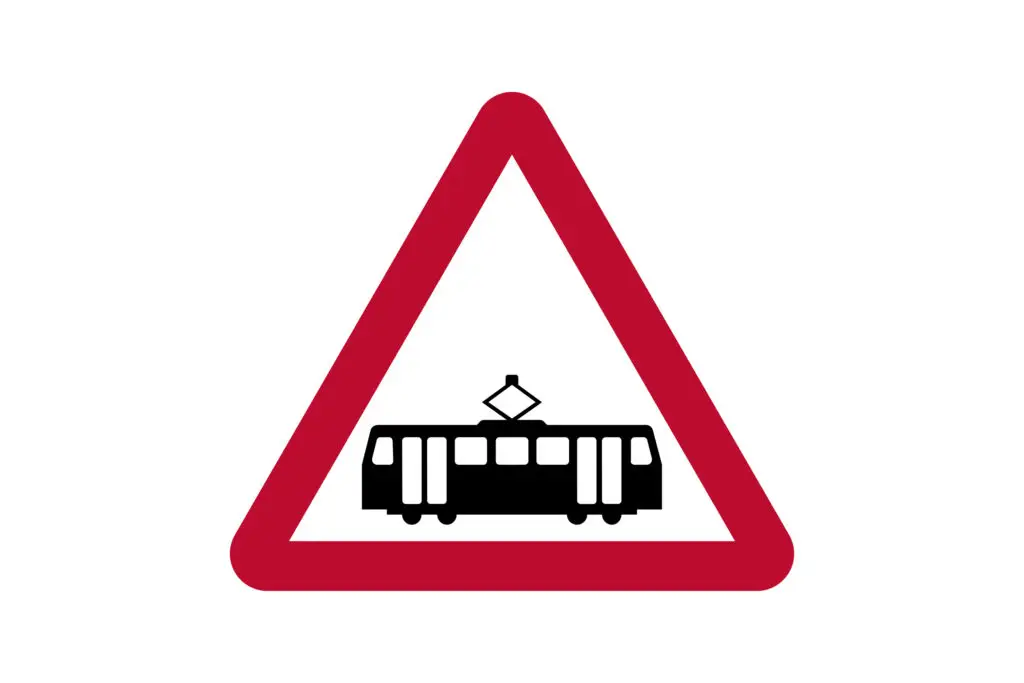
a) Trams have priority at the next junction
b) No trams are allowed beyond this point
c) Warning of trams crossing ahead
d) End of tram lane
Answer: c) Warning of trams crossing ahead ✅
Explanation: A triangular sign warns of a hazard. This one warns that trams may cross.
✅ Now the test reads just like a practice exam