All ADI Part 1 Theory Test Quizes

On this page
ToggleADI Theory Test 1
ADI Part 1 Theory Band Tests
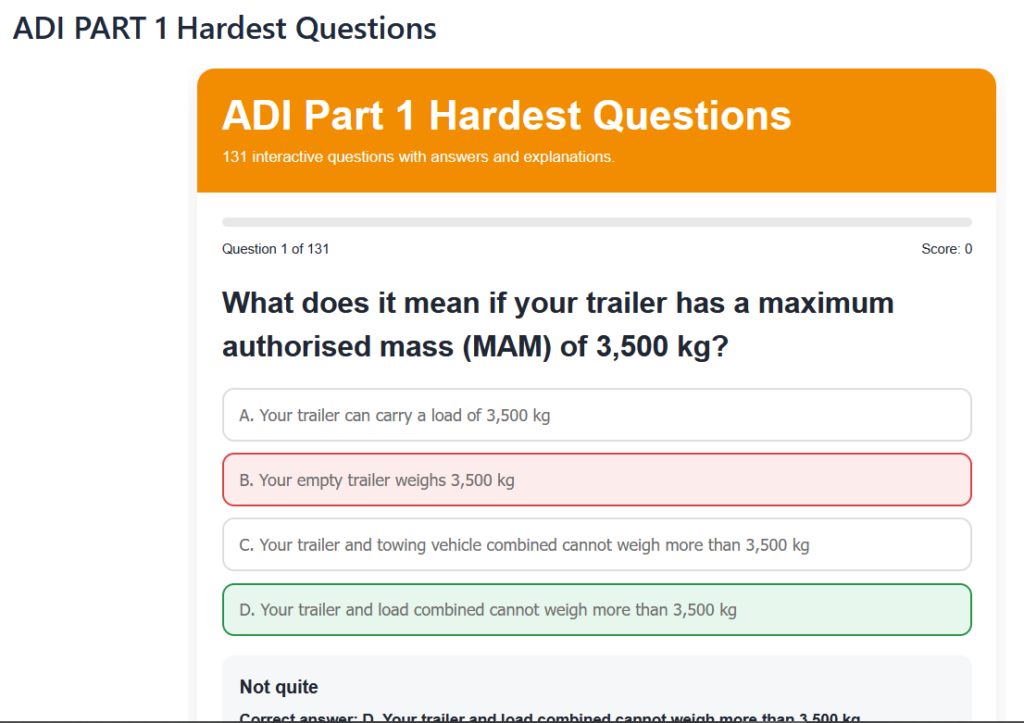
The ADI theory test consists of questions from 4 different categories/bands. Practice each band below. Each test uses all the questions from the specific band.

ADI PART 1 COACHING
ADI Part 1 Question Categories
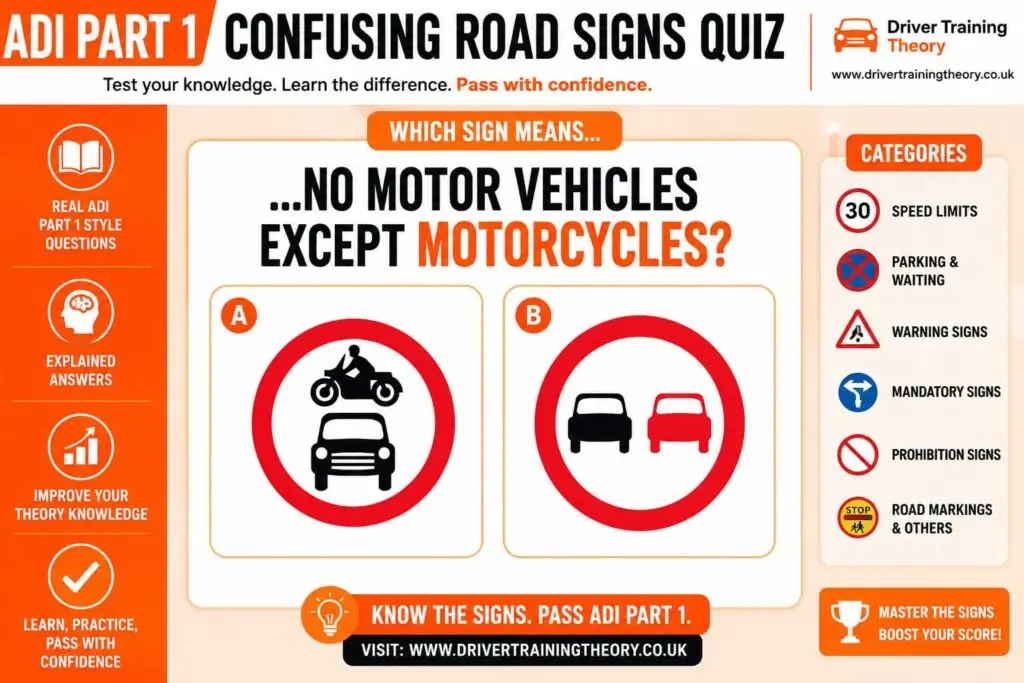
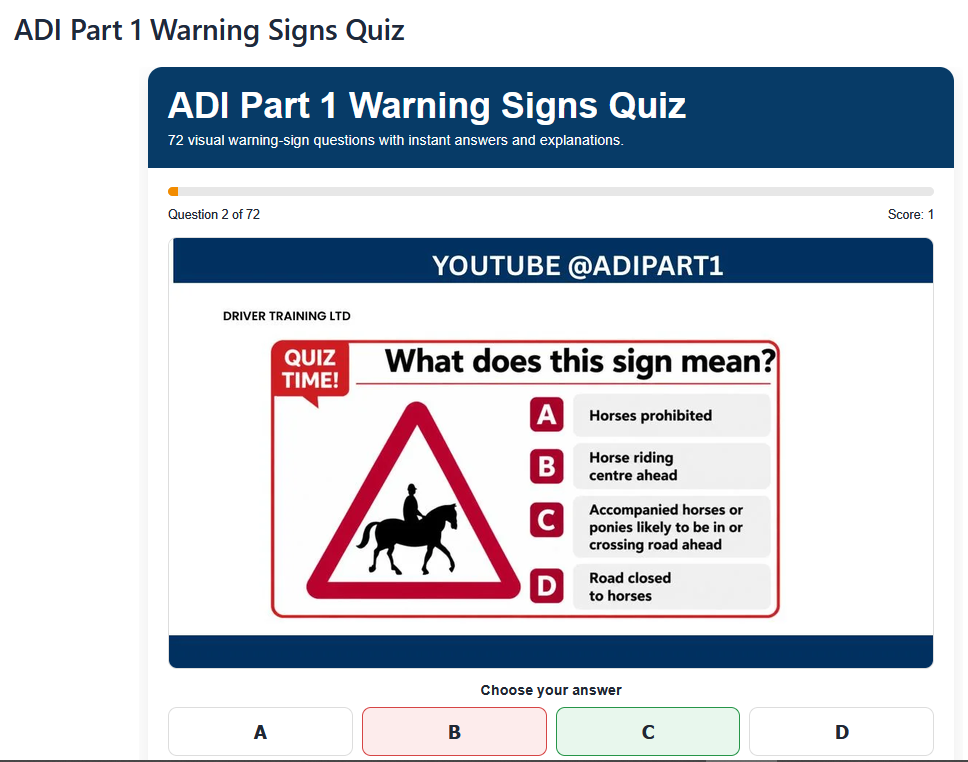
ADI PART ONE ROADSIGNS
HOW TO BOOK YOUR ADI PART 1
ADI PART ONE QUICK FACTS
ADI PART 1 - How the questions are written
How Are ADI Part 1 Theory Test Questions Written?
One of the biggest mistakes candidates make is assuming the ADI Part 1 theory test is designed to catch them out. It isn’t. The questions are carefully written to assess your knowledge, understanding and ability to apply the rules of the road in real situations.
However, they are written very precisely. Missing a single word can completely change the correct answer.
Read Every Word Carefully
Many candidates already know the subject, but they answer too quickly.
The DVSA often changes just one word, such as:
- always
- usually
- must
- should
- except
- first
- best
- most
These small words completely change the meaning of the question.
Example Which vehicle MUST obey a 30 mph speed limit?
compared with
Which vehicle MAY travel at 30 mph?
The subject is almost identical, but the correct answer may be different because of the wording.
Look for the Key Instruction
Before reading the answers, identify exactly what the question is asking.
Ask yourself:
- What is the subject?
- What action is being asked?
- Is it asking for the safest answer?
- Is it asking what you should do first?
- Is it asking for one answer or several?
This prevents choosing an answer that is true but doesn’t actually answer the question.
The DVSA Often Wants the BEST Answer
Many answers may seem reasonable.
Your task is to choose the best or most appropriate response.
For example:
You see a hazard ahead. What should you do?
Several answers might reduce risk.
The correct answer will normally be the one that deals with the hazard earliest and most safely.
Professional drivers are expected to think ahead rather than simply react.
Don’t Add Information That Isn’t There
Candidates often imagine extra details.
For example, a question may simply ask about approaching a junction.
Some candidates begin imagining:
- heavy rain
- children nearby
- poor visibility
- a busy road
Unless the question states these things, don’t assume them.
Answer only the question that has been asked.
Watch Out for Negative Words
Words such as:
- NOT
- EXCEPT
- LEAST
- NEVER
are easy to overlook.
These completely reverse the meaning of the question.
A useful technique is to pause briefly whenever you see one of these words before looking at the answers.
Similar Answers Are Deliberate
Sometimes two answers look almost identical.
For example:
- Slow down and stop if necessary.
- Stop and then slow down.
Only one follows the correct sequence.
Read every answer fully before making your choice.
Think Like a Safe Driver
The DVSA doesn’t simply test whether you know the Highway Code.
It tests whether you can apply that knowledge safely.
When you’re unsure, ask yourself:
“Which option shows the safest, most responsible and most professional approach?”
Very often, that will guide you to the correct answer.
Avoid the “Lucky Guess”
Many candidates answer correctly but don’t actually understand why.
That becomes a problem later when the same rule appears in a different scenario.
Instead of memorising answers, learn the reason behind them.
Ask yourself:
- Why is this correct?
- What danger is it preventing?
- What could happen if I chose another option?
Understanding the reasoning makes it much easier to answer unfamiliar questions confidently.
Remember That Every Word Matters
The difference between passing and failing can be just a few marks.
Taking an extra five seconds to read the question carefully is often far more valuable than rushing to finish early.
The best ADI candidates don’t simply recognise familiar questions—they understand exactly what the question is asking and why one answer is safer or more appropriate than the others.
Quick Tips for Answering DVSA Questions
- Read the entire question before looking at the answers.
- Watch for words such as NOT, EXCEPT, FIRST, BEST, MOST and ALWAYS.
- Don’t assume information that isn’t included in the question.
- Read every answer before making your choice.
- Think about the safest and most professional response.
- Understand why an answer is correct instead of memorising it.
This approach will not only improve your ADI Part 1 score but will also help you become a more knowledgeable and effective driving instructor.
How the DVSA Tests the Same Knowledge in Different Ways
How the DVSA Tests the Same Knowledge in Different Ways
One rule. Three different question styles.
The DVSA doesn’t simply repeat the same question. Instead, it tests whether you can apply the same knowledge in different situations. Here are some examples.
Example 1 – Zebra Crossing
| Version | Example Question | What the DVSA is Testing |
|---|---|---|
| Standard | What should you do when approaching a zebra crossing? | Basic Highway Code knowledge |
| Scenario | You’re approaching a zebra crossing and someone is waiting to cross. What should you do? | Applying the rule in context |
| Professional (ADI) | A pupil approaches a zebra crossing too quickly. What advice would you give? | Teaching ability and understanding |
Example 2 – Speed Limits
| Version | Example Question | What the DVSA is Testing |
|---|---|---|
| Standard | What is the national speed limit on a single carriageway for a car? | Knowledge |
| Scenario | You’re driving on a wet rural road. Should you always drive at the speed limit? | Risk awareness |
| Professional | How would you explain to a learner why the speed limit isn’t always the safest speed? | Coaching and instructional skills |
Example 3 – Meeting Traffic
| Version | Example Question | What the DVSA is Testing |
|---|---|---|
| Standard | What should you do when meeting an oncoming vehicle on a narrow road? | Basic procedure |
| Scenario | A bus has stopped opposite parked cars. What should you do? | Hazard recognition |
| Professional | How would you help a pupil decide who should give way? | Fault analysis and coaching |
Example 4 – Roundabouts
| Version | Example Question | What the DVSA is Testing |
|---|---|---|
| Standard | Who has priority at a roundabout? | Highway Code knowledge |
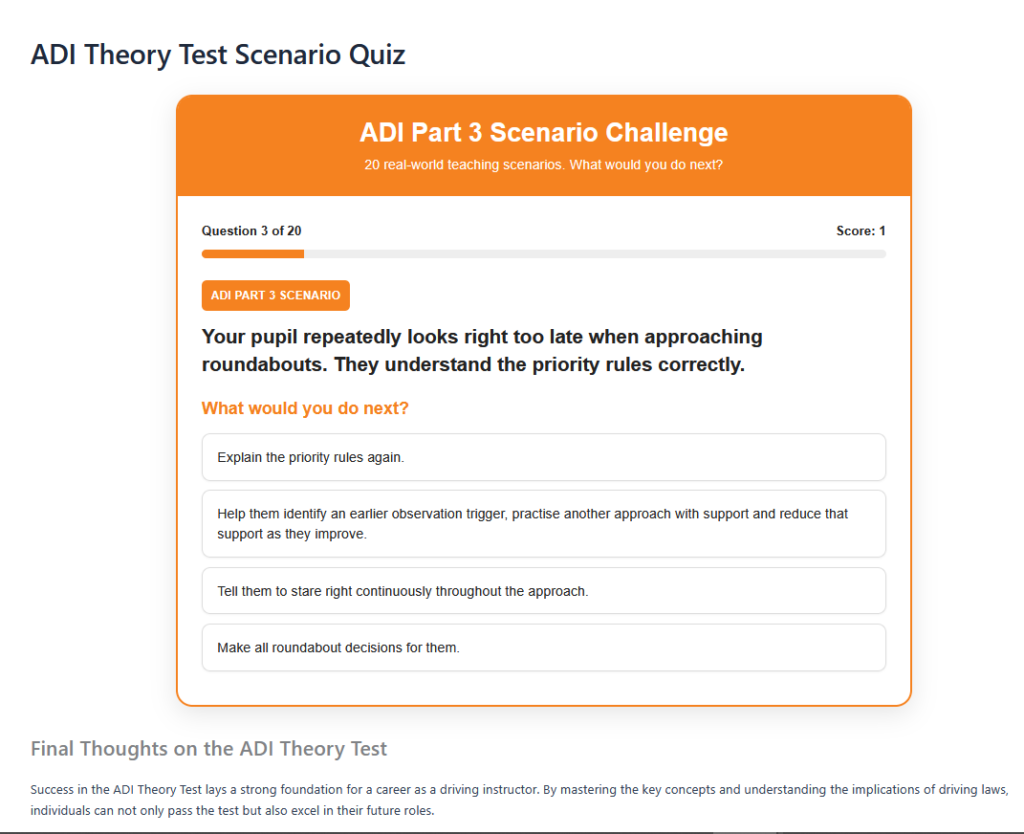
| Scenario | A vehicle is signalling left but continues around the roundabout. What should you do? | Observation and planning |
| Professional | A pupil keeps looking only to the right. How would you develop their observation routine? | Instructional techniques |
Example 5 – Hazard Perception
| Version | Example Question | What the DVSA is Testing |
|---|---|---|
| Standard | What is a developing hazard? | Knowledge |
| Scenario | You’re approaching a junction and see a child running towards the kerb. When should you respond? | Anticipation |
| Professional | How would you teach a learner to recognise developing hazards earlier? | Teaching and coaching |
Example 6 – Mirrors
| Version | Example Question | What the DVSA is Testing |
|---|---|---|
| Standard | When should you check your mirrors before changing direction? | Knowledge |
| Scenario | You’re about to overtake a cyclist. Which mirrors should you check? | Application |
| Professional | Your pupil changes lane without checking mirrors. How would you address this? | Fault correction |
Example 7 – Traffic Signs
| Version | Example Question | What the DVSA is Testing |
|---|---|---|
| Standard | What does this road sign mean? | Recognition |
| Scenario | You see this sign while towing a trailer. How should it affect your driving? | Interpretation |
| Professional | How would you help a pupil remember the difference between warning, regulatory and information signs? | Teaching strategy |
Example 8 – Emergency Vehicles
| Version | Example Question | What the DVSA is Testing |
|---|---|---|
| Standard | What should you do when an emergency vehicle approaches? | Highway Code |
| Scenario | You’re stopped at traffic lights with an ambulance behind you. What should you do? | Judgement |
| Professional | A pupil panics whenever they hear a siren. How would you build their confidence? | Coaching skills |
Example 9 – Overtaking
| Version | Example Question | What the DVSA is Testing |
|---|---|---|
| Standard | When should you avoid overtaking? | Knowledge |
| Scenario | You’re following a tractor on a country road. What factors should you consider before overtaking? | Decision making |
| Professional | Your pupil overtakes without planning. How would you improve their judgement? | Risk management |
Example 10 – Eco-Safe Driving
| Version | Example Question | What the DVSA is Testing |
|---|---|---|
| Standard | How can smooth driving reduce fuel consumption? | Knowledge |
| Scenario | You’re repeatedly accelerating and braking in traffic. What effect does this have? | Application |
| Professional | How would you demonstrate economical driving to a learner? | Teaching technique |
Why This Matters
Many candidates make the mistake of memorising individual questions. The DVSA isn’t testing whether you’ve seen a question before—it’s testing whether you understand the principle behind it.
A good driving instructor should be able to:
- Recognise the rule.
- Apply it in different situations.
- Explain why it exists.
- Teach it clearly to someone else.
If you can answer all three versions of each question—Standard, Scenario and Professional—you’re much better prepared for the ADI Part 1 theory test than someone who has simply memorised answers. This is the kind of original, experience-based content that also helps distinguish your page from typical revision sites.
ADI PART 1 Common mistakes
ADI Part 1 Frequently Asked Questions
How many questions are in the ADI Part 1 theory test?
The ADI Part 1 theory test contains 100 multiple-choice questions. These are divided equally across four subject bands, with 25 questions in each band. You must demonstrate knowledge across every topic rather than relying on strength in just one area.
What is the pass mark for ADI Part 1?
To pass the multiple-choice section, you must score at least 85 out of 100 overall. You must also score at least 20 out of 25 in each of the four bands. This means a high overall score alone is not enough if you perform poorly in one subject area.
Is there a hazard perception test?
Yes. After completing the multiple-choice questions, you’ll take the hazard perception test. This consists of 14 video clips, each containing one developing hazard, with one clip containing two hazards. You need to score at least 57 out of 75 to pass.
Are the ADI Part 1 questions the same as the learner driver theory test?
No. While some Highway Code and road safety topics overlap, the ADI Part 1 theory test is much more demanding. It includes instructional techniques, professional responsibilities, driving instructor standards and topics that learner drivers are not tested on.
Are the real DVSA questions available online?
The DVSA does not publish its live examination questions. However, high-quality revision resources use questions written in the same style and covering the same syllabus, helping you prepare for the real test.