What Is a Zebra Crossing With a Central Refuge?
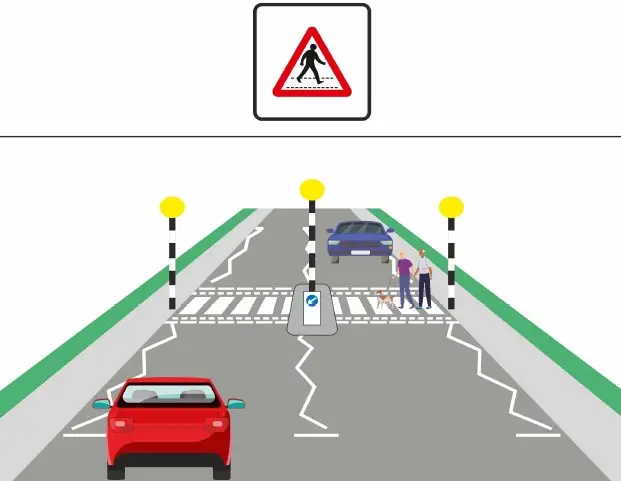
A zebra crossing with a central refuge, sometimes called a central island, allows pedestrians to cross a road in two stages rather than having to cross the whole road in one movement.
It has the familiar features of a normal zebra crossing, including black and white stripes, flashing yellow Belisha beacons and zig-zag markings on the approaches, but there is a pedestrian refuge in the middle of the road where people can wait before completing the second part of their crossing.
The important rule for learner drivers is that when a zebra crossing is divided by a central island, each half is treated as a separate crossing.
How Does a Zebra Crossing With a Central Refuge Work?
Imagine a pedestrian is crossing a busy road from your right to your left and there is a central refuge between the two directions of traffic. They may cross the opposite side of the road first and then stop safely on the central island before crossing your side.
Because the two halves are treated as separate crossings, a pedestrian who is still crossing the opposite half does not automatically require traffic on your side to stop.
However, good observation is essential because once the pedestrian reaches the central refuge, they may be intending to continue across your half of the road. You should recognise this early, assess their intentions and be prepared to give way.
Why Is the Central Refuge Important?
The refuge makes crossing wider or busier roads easier because pedestrians do not necessarily need to find a safe opportunity to cross both directions of traffic at the same time.
From a driver’s point of view, however, the island changes how the crossing should be assessed. Rather than seeing the entire zebra crossing as one continuous crossing, you need to think of it as two individual zebra crossings separated by the refuge.
This is particularly important for learner drivers because simply seeing somebody on the opposite half of the crossing and immediately stopping may not always be necessary, while failing to notice somebody waiting on the central refuge could leave you reacting far too late.
What Should a Driver Do?
As you approach, identify the zebra crossing early, check your mirrors and look towards the pavements as you normally would, but also pay particular attention to the central refuge.
A pedestrian may already be standing there waiting to cross your half of the road, so don’t concentrate only on people approaching from the pavement.
You should give way to pedestrians waiting to cross your section of the zebra crossing and MUST give way when a pedestrian has moved onto the crossing.
The aim should always be to recognise what is developing early enough to slow down smoothly rather than arriving at the crossing quickly and braking sharply at the last moment.
A Simple Way to Remember It
For theory-test purposes, there is a very simple rule worth remembering:
Zebra crossing with no central island = one crossing.
Zebra crossing divided by a central island = two separate crossings.
So if a pedestrian has crossed the opposite carriageway and is standing on the central refuge, treat them in exactly the same way as you would a pedestrian waiting at the pavement on your side. Observe them carefully, anticipate that they may want to cross and be prepared to give way.
What Learner Drivers Need to Remember
The central refuge doesn’t make the zebra crossing more complicated once you understand the basic principle because it simply divides the crossing into two.
Look well ahead for the zig-zag markings and Belisha beacons, check both pavements and the central refuge for pedestrians, adjust your speed early and remember that each side of a zebra crossing divided by a central island is a separate crossing.
That small detail is important for the theory test, but more importantly, understanding it helps you make better and safer decisions when you encounter these crossings on the road.