What Is a Staggered Crossing?
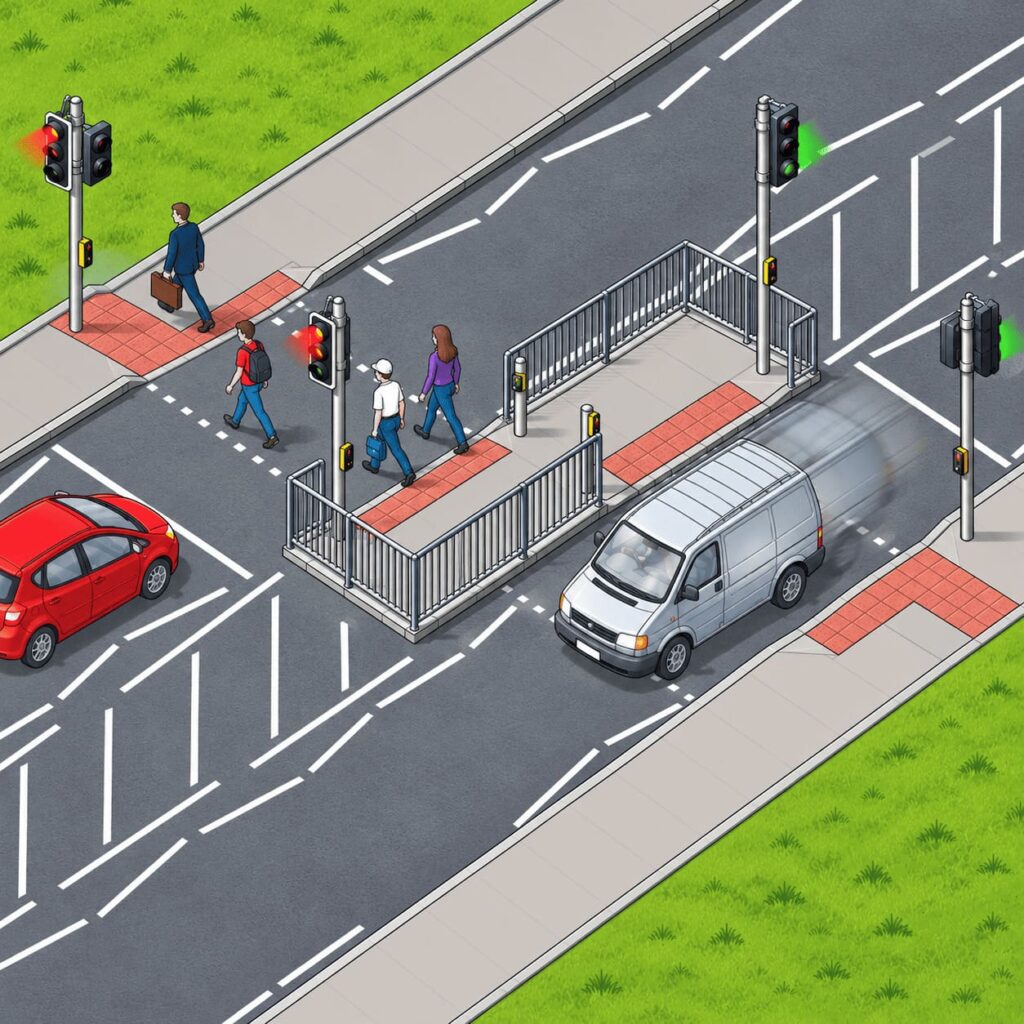
A staggered crossing is a pedestrian crossing that is divided into two separate sections by a central refuge island. Instead of walking straight across the whole road in one movement, pedestrians cross one half of the road, reach the central island, then turn slightly before crossing the second half.
The important point for your theory test is that a staggered crossing is treated as two separate crossings. Each half normally has its own pedestrian signals and traffic-light sequence, so a green pedestrian signal for one section does not mean that it is safe to cross the other section.
When driving towards a staggered crossing, pay attention to the signals controlling your section of the road. Be prepared for pedestrians who may be crossing, waiting on the central island or approaching the crossing. Never assume that someone waiting on the island will remain there.
You can recognise a staggered crossing because the two crossing points are not directly in line with each other. The central island usually guides pedestrians along a short fenced or paved section before they reach the second crossing. This staggered layout encourages pedestrians to face towards approaching traffic before crossing the next part of the road.
A useful theory-test rule to remember is: in line = one crossing, staggered = two crossings. If the crossings on either side of a central island are in line, they are treated as a single crossing. If they are staggered, each side is treated separately, so pedestrians must obey the signals for each individual section.