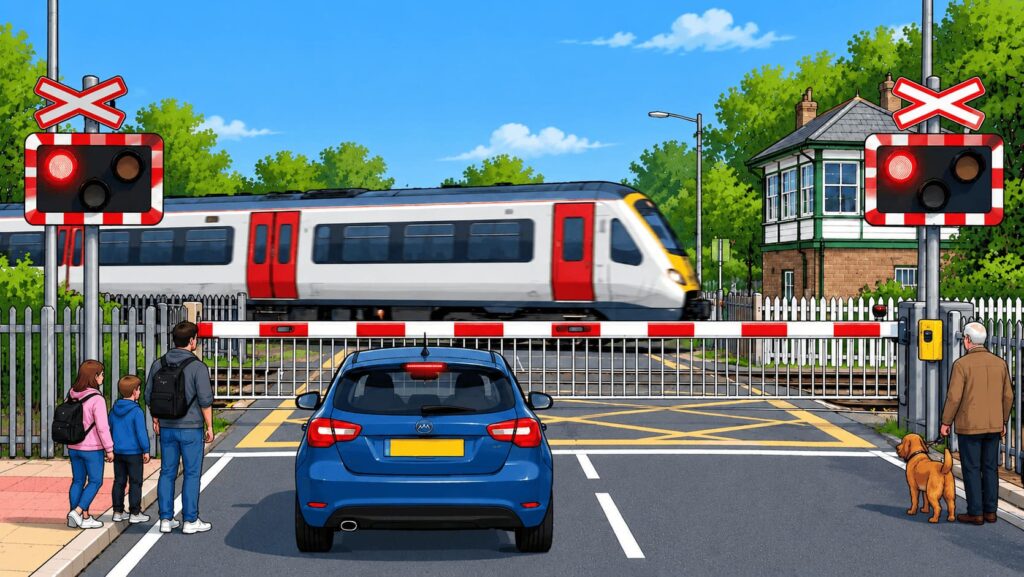
What Is a Level Crossing?
A level crossing is a place where a railway line crosses a road or path at the same level, rather than the railway passing over a bridge or through a tunnel. Because road users and trains use the same crossing point, drivers, cyclists and pedestrians must take particular care and obey any signs, signals or barriers.
Level crossings can look quite different. Some have barriers or gates, flashing red warning lights and audible alarms, while others may have fewer controls. The warning system used depends on the type of crossing, but its purpose is always the same: to prevent road users entering the railway when a train is approaching.
When the red lights begin flashing, you must stop and must not cross the stop line. You must also stop if a barrier is lowering or has already come down. Never try to weave around barriers or attempt to cross because you think there is enough time before the train arrives. Trains can approach quickly and cannot stop in the same way as a road vehicle.
Before driving across, make sure there is enough space on the other side for your entire vehicle. Never enter a level crossing if traffic ahead could leave you stopped on the railway line. Once it is safe and the signals permit you to proceed, cross without unnecessary delay and keep moving until your vehicle is completely clear of the railway.
For the theory test, remember that flashing red lights at a level crossing mean STOP. If the barriers rise but the red lights continue flashing, you must remain stopped because another train may be approaching. Only proceed when the warning lights have stopped flashing and any barriers have fully opened.