You must not use hazard warning lights while moving, except to warn traffic behind when you slow suddenly on a motorway or unrestricted dual carriageway. Never use hazard warning lights to excuse dangerous or illegal parking.
It’s important to keep a safe distance from the vehicle in front at all times. This still applies in congested tunnels, even if you're moving very slowly or have stopped. If the vehicle in front breaks down, you may need room to manoeuvre past it.
If possible, lay the casualty down. Protect yourself from exposure to blood and, when you're sure there's nothing in the wound, apply firm pressure using clean material.
If a casualty is unconscious, you need to check that they're breathing normally. Look for chest movements, look and listen for breathing, and feel for breath on your cheek.
If a casualty is not breathing normally, cardiopulmonary resuscitation (CPR) may be needed to maintain circulation. Place two hands on the centre of the chest and press down hard and fast – around 5–6 centimetres and about twice a second.
The effects of shock may not be immediately obvious. Warning signs to look for include • a rapid pulse • sweating • pale grey skin • rapid shallow breathing.
After a casualty has been placed in the recovery position, make sure their airway remains open and monitor their condition until medical help arrives. Where possible, do not move a casualty unless there’s further danger.
If someone has been injured, the sooner proper medical attention is given the better. Ask someone to phone for help or do it yourself. An injured person should only be moved if they’re in further danger. An injured motorcyclist’s helmet should not be removed unless it's essential.
Lorry drivers can be unaware of objects falling from their vehicles. If you see something fall onto a motorway, look to see if the driver pulls over. If they do not stop, do not attempt to retrieve the object yourself. Pull onto the hard shoulder near an emergency telephone and report the hazard.
Follow the instructions given by the signs or by tunnel officials. In congested tunnels, a minor incident can soon turn into a major one, with serious or even fatal results.
An adult casualty is not breathing normally. To maintain circulation, place two hands on the centre of the chest. Then press down hard and fast – around 5–6 centimetres and about twice a second.
If you’re the first to arrive at a crash scene, the first concerns are the risk of further collision and fire. Ensuring that vehicle engines are switched off will reduce the risk of fire.
Use hazard warning lights so that other traffic knows there’s a need for caution. Make sure the emergency services are contacted; do not assume it's already been done.
Do not remove a motorcyclist's helmet unless it's essential. Remember they may be suffering from shock. Do not give them anything to eat or drink, but do reassure them confidently.
At the scene of an incident, always be aware of danger from further collisions or fire. The first priority when dealing with an unconscious person is to make sure they can breathe. This may involve clearing their airway if you can see an obstruction or if they’re having difficulty breathing.
Remember this procedure by saying DR ABC. This stands for Danger, Response, Airway, Breathing, Circulation. Give whatever first aid you can and stay with the injured person until a medical professional takes over.
There are a number of things you can do to help, even without expert training. Be aware of further danger from other traffic and fire; make sure the area is safe. People may be in shock.
Do not give them anything to eat or drink. Keep them warm and comfortable and reassure them. Do not move injured people unless there’s a risk of further danger.
A casualty suffering from shock may have injuries that are not immediately obvious. Call the emergency services, then stay with the person in shock, offering reassurance until the experts arrive.
The motorcyclist is in an extremely vulnerable position, exposed to further danger from traffic. Approaching vehicles need advance warning in order to slow down and safely take avoiding action or stop.
Do not put yourself or anyone else at risk. Use the hazard warning lights on your vehicle to alert other road users to the danger.
If a young child has stopped breathing, first check that their airway is open and then begin CPR. With a young child, you may only need to use one hand and you should not press down as far as you would with an adult. Continue the procedure until the child is breathing again or until a medical professional takes over.
It’s important to make sure that the airway is open before you start CPR. To open the casualty’s airway, place your fingers under their chin and lift it forward.
Your priority is to cool the burns with clean, cool water. Its coolness will help take the heat out of the burns and relieve the pain. Keep the wound doused for at least 20 minutes. If blisters appear, do not attempt to burst them, as this could lead to infection.
You should protect yourself from exposure to blood, and then apply firm pressure over the wound to stem the flow of blood. As soon as practical, fasten a pad to the wound with a bandage or length of cloth. Use the cleanest material available.
Do not move a casualty unless there's further danger; for example, from other traffic or fire. They may have unseen or internal injuries. Moving them unnecessarily could cause further injury. Do not remove a motorcyclist’s helmet unless it’s essential.
When the area is safe and there's no danger from other traffic or fire, it's better not to move casualties. Moving them may cause further injury.
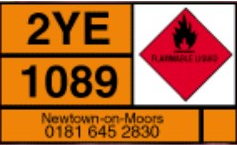
Tankers will display a hazard warning plate on the side and rear of the vehicle. Details of hazard warning symbols are given in The Highway Code. If a tanker is involved in a collision, you may need to report the tanker's hazard labelling to the emergency services.
You must stop if you've been involved in a collision that results in injury or damage. The police may ask to see your driving licence and insurance details at the time or later at a police station.
It's important to make sure that the emergency services arrive as soon as possible. When a person is unconscious, they could have serious injuries that are not immediately obvious.
The most immediate danger is further collisions and fire. You could warn other traffic by switching on hazard warning lights, displaying an advance warning triangle or sign (but not on a motorway), or by any other means that does not put you or others at risk.
The DR ABC code has been devised by medical experts to give the best outcome until the emergency services arrive and take care of casualties. DR ABC is a first aid acronym that stands for Danger, Response, Airway, Breathing, and Circulation See our site
If someone is suffering from shock, try to keep them warm and as comfortable as you can. Do not give them anything to eat or drink but reassure them confidently and try not to leave them alone.
When someone is injured, any movement that’s not absolutely necessary should be avoided, since it could make the injuries worse. Unless it's essential to remove a motorcyclist's helmet, it’s generally safer to leave it in place.
Briefly using your hazard warning lights will warn the traffic behind you that there's a hazard ahead. Turn them off again when following drivers have seen and responded to your signal.
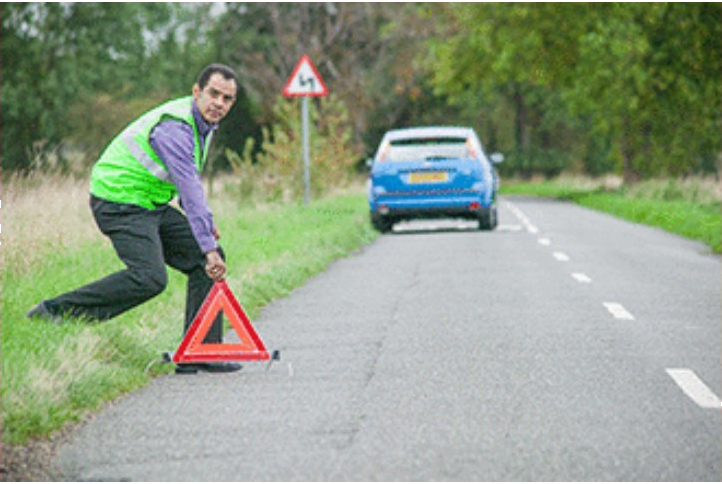 You've broken down on a two-way road. You have a warning triangle. At least how far from your vehicle should you place the warning triangle?Tap to reveal
Advance warning triangles fold flat and do not take up much room. Use one to warn other road users if your vehicle has broken down or if there has been an incident. Place it at least 45 metres (147 feet) behind your vehicle (or the incident), on the same side of the road or verge.
Place it further back if the scene is hidden by, for example, a bend, hill or dip in the road. Do not use warning triangles on motorways.
If your vehicle breaks down on a level crossing, your first priority is to get everyone out of the vehicle and clear of the crossing. Then use the railway telephone, if there is one, to tell the signal operator. If you have time before the train arrives, move the vehicle clear of the crossing, but only do this if the alarm signals are not activated.
A tyre bursting can lead to a loss of control, especially if you’re travelling at high speed. Using the correct procedure should help you to stop the vehicle safely.
Pull up on the hard shoulder or in an emergency area and call for assistance. Do not attempt to repair your vehicle while it's on the hard shoulder, because of the risk posed by traffic passing at high speeds.
If the warning bells ring, leave the vehicle and get any passengers well clear of the crossing immediately.
If you're wearing sunglasses, you should remove them before driving into a tunnel. If you do not, your vision will be restricted, even in tunnels that appear to be well lit.
Before entering a tunnel, you should switch on your dipped headlights, as this will allow you to see and be seen. In many tunnels, it's a legal requirement. Do not wear sunglasses while you're driving in a tunnel.
The fuel in your vehicle can be a dangerous fire hazard. If you smell fuel, check out where it's coming from. Never • use a naked flame near the vehicle if you can smell fuel • smoke when refuelling your vehicle.
If any object falls onto the motorway carriageway from your vehicle, pull onto the hard shoulder near an emergency telephone and call for assistance. Do not stop on the carriageway or attempt to retrieve anything.
Make sure you know what the different warning lights mean. An illuminated warning light could mean that your car is unsafe to drive. If you’re not sure about the problem, get a qualified mechanic to check it.
A broken-down vehicle in a tunnel can cause serious congestion and danger to other road users. If your vehicle breaks down, get help without delay. Switch on your hazard warning lights, then go to an emergency telephone to call for help.
f it’s possible, and you can do so without causing further danger, it may be safer to drive a vehicle that's on fire out of a tunnel. The greatest danger in a tunnel fire is smoke and suffocation.
First, get yourself and anyone else well away from the crossing. If there’s a railway telephone, use that to get instructions from the signal operator. Then, if there’s time, move the vehicle clear of the crossing.
If you're in a collision that causes damage or injury to any other person, vehicle, animal or property, by law you must stop. Give your name, the vehicle owner’s name and address, and the vehicle’s registration number to anyone who has reasonable grounds for requesting them.
Try to keep calm and do not rush. Make sure that you've shared all the relevant details with the other driver before you leave the scene. If possible, take pictures and note the positions of all the vehicles involved.
If the property owner is not available at the time, you must inform the police about the incident. This should be done as soon as possible, and in any case within 24 hours.