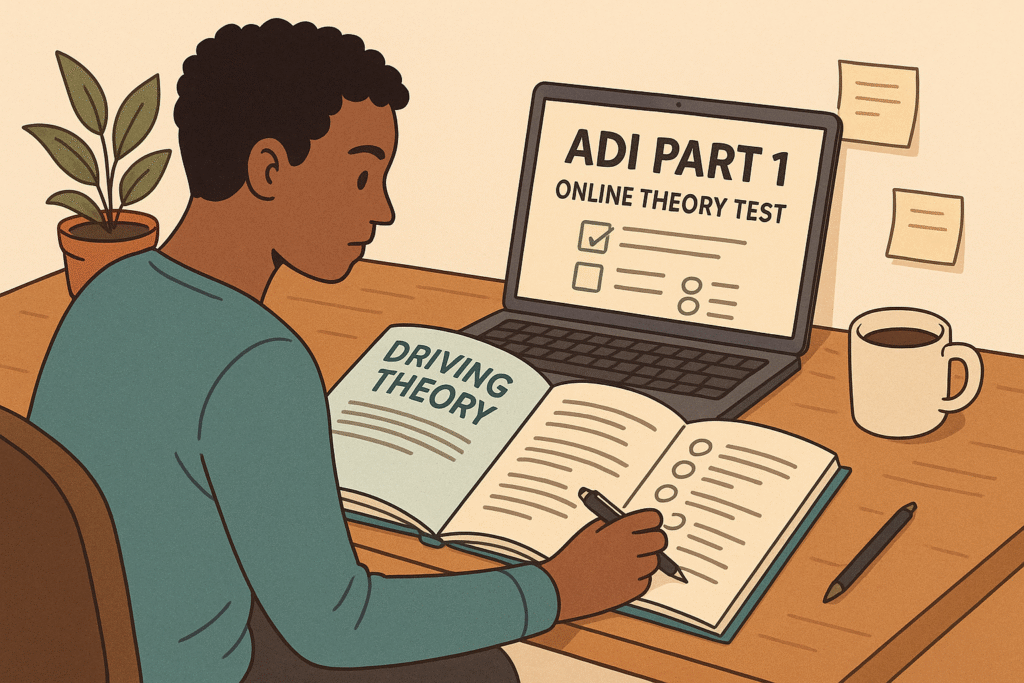
ADI part 1

ADI Part 1 Questions How to Revise the Smart Way In this guide, I’ll walk you through how to revise for ADI Part 1 the right way – not by cramming answers, but by learning the subject. Along the way, I’ll bust the myth that all the DVSA questions are published (they aren’t), and give you tips on how to tackle tricky topics like offside bus lanes and bus gates that catch many people out.
ADI part 1

ADI Theory Test Practice Questions How to Revise the Smart Way (Not Just Memorise)

ADI Theory Test Questions How to Revise the Smart Way ADI THEORY TEST PRACTICE ADI Part 1 Questions How to Revise the Smart Way – So, you’ve set your sights on becoming an Approved Driving Instructor (ADI) and are preparing for the Part 1 Theory Test. Good choice. But as any seasoned ADI will tell you – and any test candidate soon discovers – the ADI Part 1 questions are not your average road sign pop quiz. This is a professional-level theory test, designed to ensure you don’t just know the Highway Code, but that you understand it deeply. ADI Theory Test Practice Part 1 Questions How to Revise the Smart Way ADI Part 1 Questions How to Revise the Smart Way In this guide, I’ll walk you through how to revise for ADI Part 1 the right way – not by cramming answers, but by learning the subject. Along the way, I’ll bust the myth that all the DVSA questions are published (they aren’t), and give you tips on how to tackle tricky topics like offside bus lanes and bus gates that catch many people out. To enhance your learning experience, consider using resources that focus on adi theory test practice, which can help you grasp the concepts more effectively. Incorporating this practice into your study routine can significantly boost your understanding and performance. What is the ADI Part 1 Test? The ADI Part 1 is the first step in your journey to becoming a qualified driving instructor. It’s split into two parts: The pass mark is high: 85/100 overall, with at least 20/25 in each of the four bands. That means you can’t afford to be strong in just one area – you need to be consistently knowledgeable across the board. Why You Can’t Just Memorise ADI Part 1 Questions Here’s the kicker: not all DVSA ADI Part 1 questions are publicly available. That’s right – even the best revision apps and books on the market don’t include every possible question you might face on the day. Many candidates fall into the trap of thinking they can just memorise a bank of questions and breeze through. But when you get hit with a question on something niche – like how to deal with a bus gate on the offside of the road – you’ll wish you’d actually studied the subject instead of just the answers. DVSA intentionally withholds some questions to ensure candidates have truly understood the material, not just rehearsed it. What Are Offside Bus Lanes and Bus Gates? Let’s take a moment to explain why questions like these are important – and tough. You won’t find a simple “What is a bus gate?” question in the test. You might get a scenario with signage or road layout, asking how you should respond. If you’ve just memorised options A, B, and C from a mock test app, you’ll be caught out. 1. Start with the Source: DVSA Publications Use official DVSA material as your primary resource: These books go beyond basic learner driver material. They dig into the why, not just the what – and that’s exactly what you need. BUY YOURS HERE 2. Use a Quality Theory Test Site – But Don’t Stop There Sites like Drivertrainingtheory.co.uk are great for practice. But use them to test your understanding, not to replace it. People often search for “ADI Part 1 mock test free” or “ADI Part 1 practice questions.” Be careful with “free” resources – not all are updated to match the current DVSA standards. 3. Create a Study Plan with Topic-Based Revision Break down your revision into the DVSA’s four key bands: Devote a few days or sessions to each. Focus on understanding, not memorising. If you’re confused about something like bus lanes or rules on emergency vehicles, dig deeper. Use DVSA manuals and government sites, not forums. 4. Watch Real-World Driving Videos YouTube has great content from driving instructors analysing real-world driving scenarios –like Driver Training Theory including bus gates, odd junctions, and city layouts. This helps visual learners and cements how these things appear in the real world, not just in diagrams. 5. Learn to Read Road Signs Like a Pro Instead of memorising the meaning of signs one by one, understand how UK road signs work: Once you grasp that, decoding unfamiliar signs in a test or real-world situation becomes easier. 6. Use Flashcards for Weak Areas Apps like Anki or Quizlet let you create digital flashcards. Focus on tricky topics like: Common Mistakes People Make When Revising for ADI Part 1 🟥 Rote learning only – Fails when unfamiliar questions appear🟥 Ignoring instructional techniques – It’s 25% of your test!🟥 Not reading the question properly – DVSA questions are often scenario-based🟥 Overconfidence from apps – Real test questions are harder and worded differently🟥 Not using official materials – Free doesn’t always mean accurate ADI Part 1 Training – Know the Subject, Not Just the Answer Preparing for the ADI Part 1 test isn’t about beating the system – it’s about proving you understand what it takes to teach others how to drive safely and legally. The DVSA knows when someone’s just memorised a list. That’s why you’ll face questions that are conceptual, scenario-based, or unreleased. It’s also why topics like offside bus lanes or bus gates aren’t just there to trip you up – they test your ability to interpret the road like a professional. So revise smart. Use the right tools, but more importantly – know the why behind every rule, sign, and technique. Because that’s what makes a great instructor. Want more help with your ADI journey?Subscribe to our newsletter for more revision tips, study guides, and insider advice from real ADIs who’ve passed all three parts.

ADI part 1

ADI Theory Test Explained

The ADI Theory Test (Part 1): Everything You Need To Know — And How To Pass With Confidence ADI theory test – Becoming an Approved Driving Instructor isn’t just about handling a car well. It’s about setting standards for others — and that begins with ADI Part 1, the theory stage. Think of this test as the foundation stone. If it’s solid, Parts 2 and 3 feel far more achievable. Below is an expanded breakdown: structure, booking, preparation, scoring, and the pitfalls that quietly catch people out. What exactly does ADI Theory test assess? The DVSA designed Part 1 to check whether you: It mirrors the responsibilities of the job: instructors don’t just pass on information — they shape habits for life. ADI THeory test The two parts of the test — in detail 1️⃣ Multiple-choice questions (100 in total) You’ll answer questions from four “bands”: Band Focus Why it matters 1. Road procedures Rules of the road, safe positioning, priorities You’ll be explaining these daily 2. Signs, control & pedestrians Signs, signals, vehicle handling, vulnerable road users Critical for beginner safety 3. Law & the driving test Legal responsibilities, insurance, disabilities, the test Instructors must advise correctly 4. Instructor skills Teaching methods, learning styles, communication Unique to ADI candidates Pass threshold (multiple-choice) This prevents gaps. Someone brilliant in road law but weak in teaching principles shouldn’t yet be teaching — and the DVSA is right to insist on balance. 2️⃣ Hazard perception (14 clips) You’ll watch real-world scenarios from the driver’s perspective. Your job? Spot developing hazards early — the moment something begins to change and forces you to adjust speed or position. Typical hazards include: The earlier you click, the more you score. Pass threshold (hazard perception) Important note: over-clicking reduces your score. The DVSA system detects “gaming” behaviour. Calm anticipation beats frantic button-tapping every time. How to book the ADI theory test Fees are modest compared to the later stages — but failing repeatedly soon adds up, so preparation still matters. ADI Theory Test What does it cost? The ADI theory test fee is typically £81 (DVSA standard price).(If fees change in the future, the principle remains: good prep is cheaper than retakes.) How long does the test take? Expect to be at the centre roughly two hours. ADI Theory Test On the day — what actually happens There’s no long wait. You’ll know straight away whether you’re moving forward. If you fail — what happens next? You can rebook, but there’s a cooling-off period. More importantly: Remember: once you pass Part 1, a two-year clock starts ticking to pass Parts 2 and 3. Passing solidly (not scraping through) gives you breathing room. The best way to revise — properly 1. Build understanding, not memory tricks Questions often test the principle behind a rule. If you know why, you’ll answer confidently. 2. Train your eyes for hazard perception Watch clips regularly. Narrate the road in your head: “Pedestrian ahead near crossing… car edging… van blocking sightline…” This is exactly what great instructors do when they demonstrate. 3. Space your learning Short daily sessions beat marathon cramming. Give knowledge time to settle. 4. Use mock tests like real exams Sit them without pausing, without checking answers — then review honestly. 5. Track your weak bands If Band 4 (teaching principles) keeps dipping, study teaching techniques specifically, not road signs again. Topics candidates often struggle with These are deeper than “what does this sign mean?” — and rightly so. Frequently asked questions ❓ Do I need special ADI study materials? Yes — ADI-level materials cover teaching topics missing from standard theory books. ❓ Does hazard perception get harder for ADIs? It’s judged more strictly — the expectation is earlier anticipation. ❓ Can I review flagged questions? Yes — you can revisit questions before submitting your multiple-choice section. ❓ Do previous theory passes help? No — everyone training as an instructor must pass Part 1 from scratch. ADI Theory take pride in thorough preparation The ADI theory test isn’t simply a hurdle. It’s the moment you begin thinking like a professional instructor. Approach it the traditional way: It’s the same attitude you’ll one day pass on to your learners — and that continuity is what keeps standards on British roads as strong as they are.

ADI part 1, Driving Theory Test Help ADvice and Training, Hazard Perception Training, LGV Theory Test, Motorcycle Theory Test, PCV Theory Test

Top 10 Reasons for Failing the theory test

Top 10 Reasons People Fail the UK Driving Theory Test Top 10 Reasons People Fail the Theory Test Top 10 reasons for failing the theory test – Failing the theory test is rarely about intelligence. It’s about preparation, habits, and underestimating a test that quietly demands respect. The rules of the road haven’t changed much over the years — but the way people approach learning them has. Top 10 reasons for failing the theory test Here are the ten most common reasons candidates fail, year after year. 1. Treating the Theory Test as “Common Sense” This is the biggest mistake of all. The Highway Code is not a set of opinions — it’s a rule book. Many questions hinge on specific wording, legal duties, or priority rules. Guessing based on what “feels right” is a fast route to failure. Good drivers know the rules. Great drivers respect them 2. Not Studying the Highway Code Properly Apps are useful, but they’re not a replacement for the Highway Code. Candidates who skip reading it miss vital details: The theory test rewards those who’ve done their homework the traditional way. Top 10 reasons for failing the theory test 3. Over-Practising Questions, Under-Understanding Answers Doing hundreds of mock questions doesn’t help if you’re memorising answers rather than learning why they’re correct. The DVSA regularly rephrases questions. If your knowledge is shallow, unfamiliar wording will catch you out. Understanding beats repetition — every time. 4. Ignoring Hazard Perception Until the Last Minute Many candidates focus heavily on the multiple-choice section and assume hazard perception is “easy marks”. It isn’t. Click too early, too late, or in a pattern — and the system marks you down. Hazard perception requires timing, anticipation, and restraint. Just like real driving. 5. Clicking Too Much in Hazard Perception More clicks do not mean more points. Excessive or rhythmic clicking triggers the anti-cheating system, scoring you zero for that clip. This single mistake alone has caused thousands of otherwise good candidates to fail. Calm, measured clicks win the day. 6. Weak Knowledge of Road Signs and Markings Road signs are a favourite testing ground for the DVSA — because they matter. Common problem areas include: If you can’t instantly recognise signs, you’re leaving marks on the table. 7. Poor Time Management in the Test Rushing leads to careless mistakes. Dwelling too long creates panic. Some candidates: The test is generous on time — but only if you stay composed. 8. Learning Out-of-Date or Unreliable Information Old books, unofficial websites, and hearsay from friends can do real damage. Rules change. The DVSA updates questions. Using approved, current materials isn’t optional — it’s essential. Trust proper sources, not social media shortcuts. 9. Letting Nerves Take Control Knowledge disappears quickly under pressure if confidence hasn’t been built properly. Many failures come from: Steady preparation builds calm confidence. There’s no substitute for it. 10. Booking the Test Too Soon Perhaps the most avoidable reason of all. Candidates often book because: The theory test isn’t something to get through. It’s something to be ready for. Theory Test Success The theory test rewards the same values that make safe drivers: Pass rates improve dramatically when learners slow down, study properly, and prepare the old-fashioned way. Get the foundations right — and the pass will follow.

ADI part 1, Driving Theory Test Help ADvice and Training, LGV Theory Test, Motorcycle Theory Test, PCV Theory Test

Theory Test Explained – What is a Ford?

What is a Ford?: The Hidden Water Hazard Every UK Driver Must Understand What is a Ford? Every now and then, the UK theory test asks a question that sounds almost too simple. One of those is: “What is a ford?”It’s the kind of thing many learners skip over, assuming it’s common knowledge. But as with so much in driving, the simplest features on the road often carry the biggest risks. A ford is, at heart, a piece of British motoring history. Long before bridges and bypasses, travellers crossed water at the shallowest point — and in many corners of the UK, that tradition remains. Today, a ford is a shallow section of a river or stream that the road passes directly through, marked by a red warning triangle and often a white plate reading “Ford”, along with a depth gauge standing like a ruler in the riverbed. Picturesque? Often.Harmless? Not always. Water levels can change in minutes — especially after heavy rain. What looks like a gentle trickle on a summer’s drive can become a strong current by autumn’s afternoon shower. That’s why the DVSA includes fords in the theory test: because recognising one and responding correctly is a genuine safety skill, not trivia. Drivers with experience — the sort who remember how things used to be done — know to approach with respect.Slow down. Assess the depth. Enter in first gear. Keep the pace steady. Test your brakes afterwards.These time-honoured habits have kept motorists safe for generations, and they still matter today. So with that grounding, let’s turn this knowledge into test-ready confidence. Theory Test Section: Fords & Water Hazards Below is a full practice module including questions, answers, and explanations — ideal as a revision tool or teaching handout. Multiple-Choice Questions Question 1 What is a ford?A) A shallow water crossing where the road passes through a stream or riverB) A type of low bridgeC) A drainage channel beside the roadD) A temporary water diversion Question 2 Which sign warns you of a ford ahead?A) Blue information signB) Red triangle with water across the roadC) Red circle with a water symbolD) Yellow diamond-shaped sign Question 3 What should you do before driving through a ford?A) Increase speedB) Sound your hornC) Assess the depth using the gaugeD) Turn on your hazard lights Question 4 Why might a ford become dangerous after heavy rain?A) More wildlife may be presentB) Water depth can rise suddenlyC) Road markings disappearD) The road surface becomes too warm Question 5 How should you drive through a ford safely?A) High gear, fast speedB) First gear, steady paceC) Neutral, coastingD) Reverse through slowly Question 6 What should you do immediately after emerging from a ford?A) Accelerate hardB) Open the bonnet to check the engineC) Gently test your brakesD) Stop in the middle of the road Question 7 If the water level at a ford looks too deep to cross, you should:A) Drive through quickly to avoid stallingB) Wait for another vehicle to test it firstC) Find an alternative routeD) Try to walk through the ford to check the depth Question 8 What does the depth gauge at a ford help you judge?A) Water temperatureB) Speed limit through the crossingC) How deep the water isD) Road gradient Question 9 Driving too fast into a ford can cause:A) Improved tractionB) Splashing that clears debrisC) Loss of steering controlD) Increased braking efficiency Question 10 What additional sign might you see next to a ford warning sign?A) “No entry”B) “Ford” written on a white plateC) A blue mini-roundabout signD) “Dual carriageway ends” Answer Key and Explanations 1 — AA ford is a shallow water crossing used instead of a bridge — part of Britain’s long road-building history. 2 — BThe correct warning sign is a red warning triangle with water across the road. 3 — CAlways check the depth using the gauge before entering. 4 — BWater levels rise quickly after rain, turning a safe ford into a dangerous one. 5 — BUse first gear, maintain steady revs, and keep the vehicle moving smoothly. 6 — CLight braking helps dry the brakes and restores normal stopping power. 7 — CIf it looks unsafe, don’t risk it. Choose another route. 8 — CThe depth gauge measures water depth at the crossing. 9 — CHitting water at speed can cause the tyres to lose grip, affecting steering control. 10 — BA supplementary “Ford” plate often sits beneath the main warning sign.

ADI part 1, Driving Theory Test Help ADvice and Training, LGV Theory Test, Motorcycle Theory Test, PCV Theory Test

Top Tips to help you pass your theory test

Top Tips to Pass Your Theory Test If you’re preparing to take and pass your theory test your driving theory test, you’re likely feeling a mix of excitement and nerves — and that’s completely normal. Whether you’re applying for a car licence, motorcycle, LGV, PCV, or even the ADI theory test for instructors, a solid understanding of the process and proper preparation can make all the difference. This guide will walk you through practical tips to give you the best possible chance of passing first time. Understand the Structure of the Theory Test The driving theory test consists of two parts: multiple-choice questions and the hazard perception test. You must pass both parts to be successful. For car drivers, the multiple-choice section contains 50 questions, and you’ll need to score at least 43 to pass. The hazard perception test involves watching 14 video clips to identify developing hazards, requiring a minimum score of 44 out of 75. If you’re preparing for the motorcycle theory test, LGV theory test, or PCV theory test, the core format is similar but the content is tailored to the specific vehicle type. ADI candidates – those training to become driving instructors – face a more advanced theory test with 100 questions, as well as a higher standard for the hazard perception element. Knowing the test format ahead of time reduces anxiety and helps target your study efforts. Use Official DVSA Resources The best way to prepare is by studying with up-to-date, official DVSA material. These resources reflect the actual questions you may face and offer the most accurate information about road rules, signs, and driving techniques. You can purchase the DVSA Theory Test Kit app or use their books and CD-ROMs to study at your own pace. There are countless unofficial apps and websites offering mock tests, but not all are reliable. Stick to those that align closely with DVSA content. If you’re preparing for the ADI theory test, make sure your resources are specific to instructor-level knowledge, covering deeper road safety, teaching techniques, and instructional responsibilities. Master the Multiple-Choice Section Success in the multiple-choice section comes from consistent, focused revision. Start by reading the Highway Code thoroughly. Make notes or flashcards for rules you find tricky to remember. Then, move on to practice questions. Many apps allow you to work by topic – such as road signs, vehicle handling, or vulnerable road users – which helps identify weak areas to focus on. Don’t rely on memorising answers; understand why each answer is correct. This approach helps if questions are worded differently on the actual test. Those taking the LGV theory test or PCV theory test should pay special attention to rules about vehicle size, weight, and safe loading – subjects unique to those licences. Practice the Hazard Perception Test The hazard perception test often catches people out, but it doesn’t have to. This part assesses your ability to spot developing hazards early. A developing hazard is something that would cause you to take action, like a car pulling out or a pedestrian stepping into the road. You’ll be shown 14 video clips, each containing at least one developing hazard. One clip will feature two. Clicking too often or too rhythmically can be penalised, so it’s important to learn what to look for and how to react naturally. Practice clips are available in the DVSA kit and many good-quality apps. Remember, LGV and PCV candidates also have to complete a separate hazard perception test as part of their CPC Module 1. Book the Test at the Right Time Don’t rush to book your theory test the moment you start learning to drive. Give yourself a few weeks to study thoroughly. Aim to complete mock tests regularly and only book once you’re passing those with confidence. That said, avoid waiting too long — momentum is key. If you’re revising well, aim to book your test within a few weeks of starting preparation. ADI theory test candidates should only book once they’ve passed multiple full-length mocks and feel confident handling both the breadth of knowledge and the time pressure. Unlike the learner theory test, the ADI version is longer and more demanding, so allow ample preparation time. Test Day Tips On the day of the test, make sure you bring the correct ID — usually your provisional licence photocard. Arrive early, stay calm, and take your time. You’ll have a short practice session before the test begins so you can get used to the computer system. Use the flag function during the multiple-choice part if you’re unsure of an answer. You can return to it later. During the hazard perception clips, stay focused but avoid over-clicking. Click once when you see a potential hazard developing, and again if the situation changes — but don’t fall into a rhythm or try to ‘beat the system.’ After the Test – What’s Next? If you pass, congratulations! You’re now one step closer to the open road. You’ll be sent a theory test pass certificate with a number you’ll need when booking your practical test. The certificate is valid for two years, so be sure to complete your practical within that time. If you don’t pass, don’t be discouraged. Review your feedback, identify where you struggled, and prepare to try again. Many successful drivers and even instructors didn’t pass on their first attempt. Whether you’re going for a car, motorcycle, LGV, PCV, or ADI theory test, persistence and preparation are the keys to success. Final Thoughts The driving theory test is a vital part of becoming a safe, knowledgeable driver — or instructor. With the right preparation, you can walk into the test centre feeling confident and come out with a pass certificate in hand. Use trusted resources, practise regularly, and give yourself time to prepare properly. Good luck!

Three paper speech bubbles with question marks
ADI part 1, Uncategorized

Everything You Need to Know About Becoming an ADI: From Theory Test to Teaching

At Driver Training Theory we understand that the journey to becoming a fully qualified driving instructor begins with passing the crucial first hurdle: the ADI Theory Test. Every candidate must complete the rigorous exam and to pass you need sound knowledge, sharp hazard perception and plenty of effective revision. That’s precisely why our services focus so intensively on tailored ADI theory test practice. When it comes to your ADI theory test practice, preparation is non-negotiable. This isn’t like the standard learner driver test. For the Approved Driving Instructor route, you’ll face a 100-question multiple choice exam and a hazard perception section, both of which demand a far higher standard of awareness, knowledge and technique. You must answer at least 85 out of 100 correctly and in each of the four bands you must score at least 20 out of 25. With that in mind, here’s how our ADI theory test practice services will set you up for success as the year’s end approaches. Why ADI Theory Test Practice matters To become one of the many new ADIs working across the UK, you must demonstrate not only driving proficiency but also instructional competence. That starts with the theory. Our ADI theory test practice helps you build a strong foundation across the four bands of knowledge assessed in the test, from road procedure to instructional techniques. By engaging with well-designed ADI theory test practice material you will familiarise yourself thoroughly with question formats and subject areas, develop your hazard perception skills by spotting developing risks quickly and accurately and gain the confidence to tackle the 90-minute multiple-choice element with ease. Entering your test with fewer surprises gives you a much higher chance of passing on your first attempt. We place emphasis on realistic, up-to-date ADI theory test practice. After all, the ADI theory exam is tougher than the standard driving theory test, with higher pass marks and stronger performance expectations all round. How we deliver effective ADI Theory Test Practice Our service centres on a structured, flexible and accessible approach to ADI theory test practice. We provide an extensive question bank with hundreds of DVSA-style ADI theory test practice questions. This ensures you cover all the necessary topics such as traffic signs, legislative knowledge, instructional technique and hazard perception. Our questions also mirror the real exam format, making them a high-quality preparation tool. We also offer mock tests under real conditions so you can familiarise yourself with the pressure and pace of the actual exam. Simulating the full 90-minute multiple-choice test plus hazard perception session helps your brain adapt and perform well under pressure. The hazard perception component is a distinct challenge in the ADI theory test practice process. It demands early recognition of developing hazards, precision in response and sustained concentration. With realistic hazard clips and detailed feedback, our ADI theory test practice ensures you are ready for this demanding section. Recognising that many aspiring ADIs balance current work or part-time commitments, our ADI theory test practice materials are optimised for mobile, tablet and desktop. This means you can revise in the evenings, on weekends or even during your commute to make the most efficient use of your time.  Our platform also records your performance in each ADI theory test practice session and highlights weaker areas, helping you target revision where it counts rather than revisiting what you already know. Why choose us for your ADI Theory Test Practice? While there are many providers offering mock tests, we know that when you’re preparing for the ADI theory test practice, the stakes are higher and the content must be tailored accordingly. Our focus is on the unique demands of the ADI pathway, covering instructor-relevant topics, high pass markers and real-life teaching scenarios. We keep our ADI theory test practice materials updated to reflect the latest standards from the Driver and Vehicle Standards Agency (DVSA), so you can be confident that you’re studying exactly what you’ll face in the exam. The difference between generic driving theory and dedicated ADI theory test practice is significant; and engaging with the right preparation is a smart move that saves you time and stress. Your November test slot: get started now With November fast approaching, now is the perfect time to ramp up your ADI theory test practice. Starting early allows you to build steady revision habits rather than cramming at the last minute. You can take multiple full-length mock ADI theory test practice sessions, monitor your progress and focus on improving any weaker topics that might otherwise hold you back.  Investing in your success means investing in high-quality ADI theory test practice. Our services are designed to maximise your readiness, strengthen your knowledge and hone your skills. This November exam window is within reach and with the right preparation, you can pass Part 1 of the ADI route with confidence and move smoothly into your training as a fully qualified driving instructor. Start your ADI theory test practice with us today and give yourself the competitive edge you deserve. With focus, consistency and the right support, your goal of becoming an Approved Driving Instructor can soon become a reality.

ADI part 1, Uncategorized

ADI Part 1 Questions 2026 Free Online Practice

Inside the ADI Part 1 Questions: Understanding the Questions, the Logic Behind Them, and How to Prepare Like a Pro With the ADI Part 1 Questions, Becoming an Approved Driving Instructor (ADI) is one of the most rewarding steps you can take in the motoring world. But before you can get behind the dual controls as a professional, the journey begins with ADI Part 1 — the theory test that separates those who’ve simply driven for years from those who truly understand driving. At first glance, Part 1 can look deceptively simple. It’s a multiple-choice test, much like the standard learner theory exam. But make no mistake — the ADI version goes far deeper. It’s designed to assess your knowledge of the Highway Code, road traffic law, instructional techniques, and driving theory at a professional level. Let’s break down what these questions look like, how they’re structured, and why preparing properly — using a trusted source like DriverTrainingTheory.co.uk— makes all the difference. ADI Part 1 Questions The Layout of the ADI Part 1 Test The ADI Part 1 theory test is made up of two sections: The questions themselves are drawn from DVSA’s official database — but here’s the twist: not all questions are published. The DVSA deliberately includes unpublished items to make sure candidates understand the concepts, not just memorise the answers. That’s where the right preparation becomes essential. Typical ADI Part 1 Question Examples Let’s look at the style of question you might see — and the kind of reasoning the test is looking for. Standard Question Example Question:When teaching a pupil about following distances on a dry road at 40 mph, what is the recommended time gap to the vehicle in front? A) 1 secondB) 2 secondsC) 3 secondsD) 4 seconds Correct answer: ✅ B – 2 seconds Explanation:This is based on the well-known two-second rule from the Highway Code. It ensures adequate stopping distance under dry conditions. However, as an instructor, you’re also expected to discuss why this matters — and to double it in wet weather. So, the ADI-level understanding isn’t just about ticking the right box, but about knowing how to explain it clearly to a learner. Twist Question Example (DVSA-Style) Question:A pupil is following another vehicle at what they believe is a “safe distance.” It suddenly starts to rain heavily. As their instructor, what should you encourage them to do? A) Maintain their distance — they were already safe.B) Drop back to at least a four-second gap.C) Slow down slightly but keep the same distance.D) Turn on hazard lights to warn others. Correct answer: ✅ B – Drop back to at least a four-second gap. Explanation:Here, the DVSA is testing whether you can apply your knowledge in context. The twist lies in how the situation evolves — it’s not just about recalling a rule, but about adjusting advice when conditions change. It’s this depth of understanding that sets ADIs apart. ADI Part 1 Questions Why Some Questions Aren’t Published The DVSA doesn’t reveal every question in its database. And that’s deliberate. If all questions were publicly available, candidates could simply memorise answers without truly understanding why those answers are correct. By including “hidden” questions, the DVSA ensures that only those with a genuine grasp of the subject can succeed. This means you need to study the principles behind the rules, not just the words on the screen — and that’s exactly what DriverTrainingTheory.co.uk helps you do. ADI Part 1 Questions How DriverTrainingTheory.co.uk Helps You Prepare At DriverTrainingTheory.co.uk, you’ll find far more than a question bank. The platform is built around the idea that understanding beats memorisation every time. Each topic area — from road procedure to hazard awareness and instructional technique — includes: You’ll also see “standard” and “twist” question formats, designed to prepare you for the kind of reasoning the DVSA expects. That means no nasty surprises on test day — you’ll be ready for anything the computer throws at you. ADI Part 1 Questions –Knowledge Over Guesswork The ADI Part 1 isn’t there to catch you out — it’s there to make sure you’re ready to teach others safely and professionally. The key is understanding the subject, not just passing a quiz. With DriverTrainingTheory.co.uk, you get a system that’s been designed by experienced driving instructors who’ve been through the process themselves. You’ll learn the material, test your knowledge, and build the confidence to move on to Part 2 and 3 knowing your foundation is solid. Because after all — good instructors aren’t just born; they’re trained. Ready to get started? Visit DriverTrainingTheory.co.uk today and begin your journey to becoming a fully qualified ADI. Study smarter, not harder — and make sure you truly understand what it means to teach safe, skilled driving for life.

ADI part 1, Driving Theory Test Help ADvice and Training, LGV Theory Test, Motorcycle Theory Test, PCV Theory Test

What Is a Bus Lane? – A Simple Guide for the UK Theory Test

What is a bus lane? Bus lanes are one of those everyday road features that learners see constantly, yet they still cause confusion in the theory test. Get them right, though, and you’re showing the examiner you understand discipline, observation, and respect for other road users – values that have always mattered on British roads.

Scroll to Top