Shared route for both cyclists and pedestrians
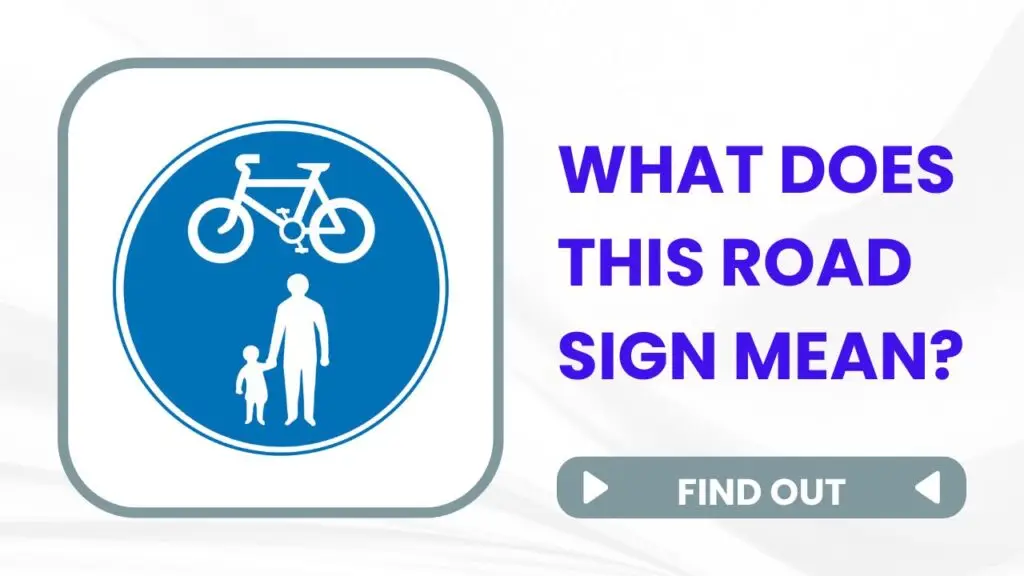
Shared Route for Pedestrians and Cyclists
The “shared route for pedestrians and cyclists” sign is a blue circular sign, because it’s giving a positive instruction (what you must do, not just a warning). It shows a pedestrian symbol and a cycle symbol together, meaning that both pedestrians and cyclists are allowed to use the same path.
There are two versions of this sign:
- Shared without segregation – pedestrians and cyclists share the same space (both symbols side by side, no dividing line).
- Shared with segregation – pedestrians and cyclists are separated by a dividing line (the symbols are shown one above the other, with a line between them).
shared route for both cyclists and pedestrians What it means for drivers
Although these signs are mainly directed at pedestrians and cyclists, drivers must also be aware of them — especially near junctions, crossings, or when joining/leaving roads by cycle routes. It’s a reminder that pedestrians and cyclists may emerge onto the road from a shared path, so extra caution and lower speed may be needed.

shared route for both cyclists and pedestrians Theory Test tip
On the theory test, this sign may appear under “road signs” questions. The key is to remember:
- Blue = mandatory (you must follow it).
- Shared path means pedestrians and cyclists can both use it — either mixed together or in separate lanes.
I often explain it like this to pupils: “Think of the blue circle as an instruction badge. If you see people and bikes inside it, that’s who the path is for.”
- Shared Route for Pedestrians and Cyclists Sign: The blue circular sign indicates a shared route for both pedestrians and cyclists, featuring symbols for both and serving as a positive instruction for their use.
- Two Types of Shared Path Signs: There are two versions: one without segregation where pedestrians and cyclists share the same space, and another with segregation separated by a line, showing the symbols in different positions.
- Implications for Drivers: Drivers should be alert for pedestrians and cyclists emerging from shared paths, especially near junctions and crossings, and adjust their speed and caution accordingly.
- Theory Test Tip on Shared Routes: On the theory test, this sign means the path is mandatory for both pedestrians and cyclists, whether they share space or lanes, often explained as an instruction badge.
- Understanding the Sign’s Meaning: The blue color indicates a mandatory route, and the presence of both symbols signifies that the path is designated for both pedestrians and cyclists.
What is the significance of the blue color in the shared route sign?
The blue color in the shared route sign indicates that it is a mandatory route that must be followed by pedestrians and cyclists using that path.
How is the shared route sign interpreted on the theory test?
On the theory test, the shared route sign signifies a mandatory route for both pedestrians and cyclists, indicating they may share the space either mixed or separated, and is like an instruction badge that must be followed.
What should drivers be aware of when they see a shared route for pedestrians and cyclists sign?
Drivers should be alert for pedestrians and cyclists emerging from shared paths, especially near junctions, crossings, or when joining or leaving roads by cycle routes, and they should adjust their speed and exercise extra caution.
What are the differences between the two versions of the shared route sign?
The two versions of the shared route sign include one without segregation, where pedestrians and cyclists share the same space, and another with segregation, where they are separated by a dividing line with the symbols positioned differently.
What does the shared route for pedestrians and cyclists sign indicate?
The shared route for pedestrians and cyclists sign is a blue circular sign that indicates both pedestrians and cyclists are allowed to use the same path, with symbols representing each.