Band 2 Progress Quizzes
80 hard diagnostic questions across Traffic Signs and Signals, Car Control, Pedestrians and Mechanical Knowledge. Complete each 20-question quiz to expose the topics that need more work.
Your progress is saved on this device. Questions and explanations are for training; always study the current Highway Code and official DVSA materials.
How to Use the ADI Part 1 Band 2 Analysis Quiz
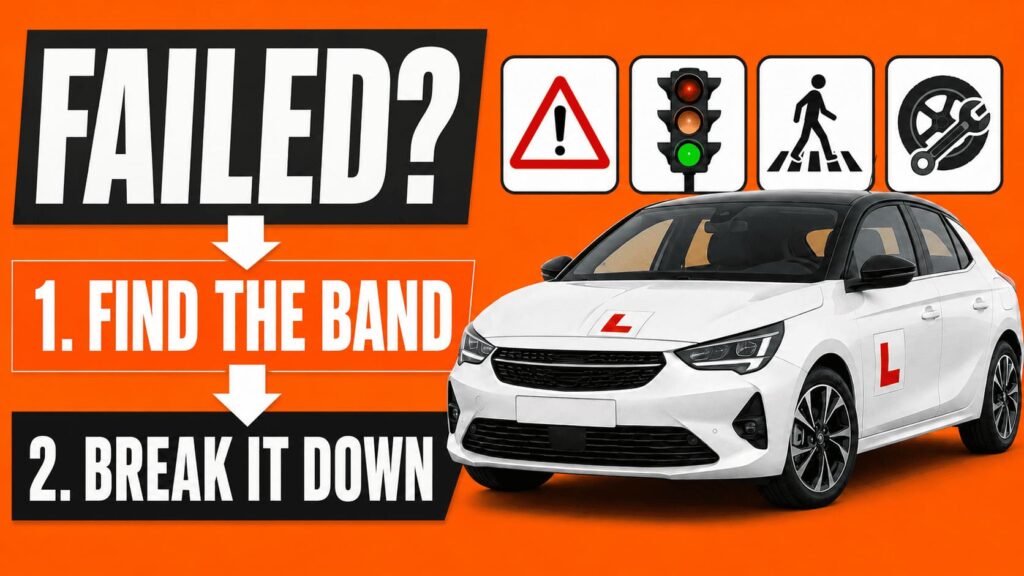
The ADI Part 1 Band 2 analysis quiz is designed to do more than tell you whether you passed or failed. Its real purpose is to help you identify exactly where your knowledge is strong and where further revision is needed.
Band 2 covers several different subject areas:
- Traffic signs and signals
- Car control
- Pedestrians and pedestrian crossings
- Mechanical knowledge
It is possible to understand one part of the band very well while having significant gaps in another. Completing one general mock test may not reveal those gaps, particularly if the questions happen to favour the subjects you already know.
The Band 2 progress quiz separates the topics so that you can analyse your knowledge properly.
ADI Part 1 Band 2 Analysis Quiz Why General Mock Tests Can Hide Your Weaknesses
Many ADI Part 1 candidates repeatedly complete full mock tests and concentrate only on the final score.
A pass can feel reassuring, but it does not necessarily prove that every part of your knowledge is secure. You may answer several traffic sign questions correctly while continuing to struggle with pedestrian crossings or vehicle mechanics.
You might also recognise questions you have answered before. In that situation, you may be remembering the answer rather than understanding the rule behind it.
A proper progress quiz should help you answer three important questions:
- Which subjects do I understand?
- Which subjects am I getting wrong?
- Do I understand why the correct answer is right?
That final question is particularly important because the DVSA does not publish every question used in the ADI Part 1 test. The wording may be unfamiliar even when the underlying subject is something you have studied.
How the Band 2 Analysis Quiz Works
The diagnostic contains four separate quizzes, with 20 hard questions in each section.
You can complete the sections individually:
- Traffic Signs and Signals
- Car Control
- Pedestrians
- Mechanical Knowledge
After answering a question, you will immediately see whether your answer was correct, together with an explanation of the rule or principle involved.
Your score for each section is saved on your device. Once all four quizzes have been completed, the diagnostic report compares your results and ranks the sections from weakest to strongest.
This gives you a much clearer revision plan than a single overall percentage.
ADI Part 1 Band 2 Analysis Quiz Start With One Section at a Time
Do not rush through all 80 questions simply to reach the final result.
Choose one section and complete it without referring to the Highway Code, notes, videos or another website. The first attempt should measure what you currently know, not what you can look up while completing the quiz.
Read every question carefully. Hard questions often include wording that tests whether you understand the precise meaning of a sign, signal or rule.
Before selecting an answer, ask yourself:
- What is the question actually asking?
- Is this a legal requirement or general advice?
- Does the wording include an important exception?
- Can I explain why my chosen answer is correct?
If you can select an answer but cannot explain it, your knowledge may not yet be secure.
ADI Part 1 Band 2 Analysis Quiz Do Not Guess and Move On
Sometimes you will be able to eliminate two answers but remain uncertain between the other two. That uncertainty is useful information.
Choose the answer you believe is correct, but make a mental note that the subject needs checking even if you happen to get it right.
A lucky correct answer should not be treated as proof of understanding.
For every question, try to finish this sentence:
“I know this is correct because…”
If you cannot complete that sentence confidently, add the topic to your revision list.
ADI Part 1 Band 2 Analysis Quiz Read Every Explanation
The explanations are one of the most important parts of the Band 2 progress quiz.
When you answer incorrectly, do not simply look at the correct option and continue. Read the explanation and identify why your original answer was wrong.
Ask yourself:
- Did I not know the rule?
- Did I misunderstand the wording?
- Did I confuse two similar signs or crossings?
- Did I overlook an exception?
- Did I rely on what seemed sensible instead of the actual rule?
This turns each mistake into useful diagnostic information.
You should also read the explanation after a correct answer. You may have reached the right answer using incomplete or incorrect reasoning.
ADI Part 1 Band 2 Analysis Quiz How to Interpret Your Score
A useful target is at least 17 correct answers out of 20 in every section.
17 to 20 Correct: Strong Knowledge
This suggests that your knowledge of the section is reasonably secure.
However, review every question you answered incorrectly or guessed. Make sure you understand the explanation rather than memorising the position of the correct answer.
14 to 16 Correct: Developing Knowledge
You have a reasonable foundation, but there are gaps that could cause problems in the real test.
Review the individual subjects behind your incorrect answers before attempting the section again.
13 or Fewer Correct: Priority Weakness
This section should become a revision priority.
Do not immediately repeat the same quiz. Return to your learning materials, study the relevant subjects and make sure you can explain the rules in your own words.
You should then attempt the quiz again after a suitable break.
ADI Part 1 Band 2 Progress Quiz How to Analyse Traffic Signs and Signals Weaknesses
If this is your lowest-scoring section, divide your mistakes into smaller groups.
These may include:
- Warning signs
- Regulatory signs
- Mandatory signs
- Road markings
- Traffic lights and filter arrows
- Motorway signals
- Level-crossing signals
- Temporary signs
- Parking, waiting and loading restrictions
Do not try to learn signs only by appearance. For each sign, learn what it means, what action you should take and whether it gives a warning, instruction or prohibition.
Pay particular attention to signs that look similar but have very different meanings.
How to Analyse Car Control Weaknesses
Car control is not simply about operating the pedals and steering wheel. The questions may test your understanding of how the vehicle behaves in difficult conditions.
Your revision may need to cover:
- Skids and loss of grip
- Aquaplaning
- ABS
- Engine braking
- Brake fade
- Steering technique
- Coasting
- Tyre failure
- Towing
- Vehicle stability
- Driving in strong winds
- Reversing observations
Try to connect the mechanical action with its effect on the vehicle. For example, do not merely memorise that you should ease off during aquaplaning. Understand that harsh braking or steering can make the loss of grip worse.
How to Analyse Pedestrian Weaknesses
The pedestrian section includes more than recognising different types of crossing.
You may need to revise:
- Zebra crossings
- Pelican crossings
- Puffin crossings
- Toucan crossings
- Pegasus crossings
- Parallel crossings
- School crossing patrols
- Pedestrians at junctions
- Vulnerable pedestrians
- Crossing zigzag restrictions
- Central pedestrian refuges
Make sure you understand the difference between what you must do and what the Highway Code says you should do.
You should also consider how pedestrians may behave in real situations. Children, older people and pedestrians with visual or hearing impairments may need more time or may be unable to judge approaching traffic accurately.
How to Analyse Mechanical Knowledge Weaknesses
Mechanical knowledge often causes difficulty because candidates try to memorise isolated facts without understanding what the vehicle systems do.
Your revision may need to include:
- Tyre tread and pressures
- Uneven tyre wear
- Engine oil
- Coolant
- Brake fluid
- Warning lights
- ABS
- The battery and alternator
- Suspension
- Steering
- Wheel alignment
- Exhaust emissions
- Safe wheel changing
For each component, learn its purpose, the warning signs of a problem and the safest action to take if a fault develops.
You do not need to become a mechanic, but an approved driving instructor should understand the basic safety checks and systems that affect a vehicle’s roadworthiness.
Create a Revision List From Your Mistakes
After completing a section, write down the subject behind every incorrect or uncertain answer.
Do not write only the question number. The question order may change, and remembering a number will not improve your knowledge.
A useful revision list might include:
- Difference between pelican and puffin crossings
- Meaning of flashing amber at a pelican crossing
- Exceptions for crossing a solid white line
- Causes of tyre shoulder wear
- Meaning of the battery warning light
- Action to take during aquaplaning
This gives you a practical list of subjects to study.
Use the Explain-It-Aloud Test
One of the best ways to check your knowledge is to explain the answer aloud as though you were teaching a learner driver.
For example, do not simply say:
“The answer is brake fade.”
Explain:
“Brake fade is a reduction in braking effectiveness caused by the brakes overheating, often following prolonged or repeated braking.”
If you cannot explain a subject clearly, return to your study materials. An ADI needs more than recognition knowledge. You will eventually need to explain these subjects accurately to other people.
Retake the Quiz Properly
Repeating the quiz immediately can produce a misleading score because you may remember the answer positions.
Instead:
- Review the subjects you got wrong
- Explain the rules in your own words
- Wait before attempting the section again
- Read each question fully
- Explain why your selected answer is correct
Aim to score at least 17 out of 20 twice, with a gap between attempts.
More importantly, make sure you can explain the answers without relying on the wording used in the quiz.
Use the Final Weakness Analysis
Once you have completed all four sections, open the Band 2 diagnostic report.
The report ranks your results from weakest to strongest. Begin your revision with the lowest-scoring area rather than automatically returning to the subject you enjoy most.
Trainees naturally prefer practising topics they already understand. It feels encouraging because the scores are usually higher. However, progress comes from concentrating on the subjects that are costing you marks.
Use the report to create a clear order:
- Revise your weakest section
- Retake it after studying
- Move to the next-lowest section
- Continue until every section reaches the target
- Finish with mixed Band 2 questions
Do Not Treat the Quiz as a Substitute for Studying
The Band 2 progress quiz is a diagnostic and revision tool. It should be used alongside the current Highway Code, Know Your Traffic Signs and appropriate DVSA learning materials.
Its purpose is to show you where to concentrate your effort.
Repeatedly answering the same questions until you remember them is not the same as learning the subject. The real ADI Part 1 test may approach the topic from a different angle or use unfamiliar wording.
Study the subject, not just the question.
Turn Your Results Into a Band 2 Training Plan
Your final score should lead to action.
If Traffic Signs and Signals is weakest, work through signs by category and explain the required driver response.
If Car Control is weakest, revise how steering, braking, tyres, speed and road conditions affect stability.
If Pedestrians is weakest, compare every crossing type and study the rules protecting vulnerable road users.
If Mechanical Knowledge is weakest, learn what the main vehicle systems do, how faults may be recognised and what action a driver should take.
The aim is not merely to pass a progress quiz. It is to build knowledge that remains useful throughout ADI Part 1, ADI Part 2, ADI Part 3 and your future career as a driving instructor.