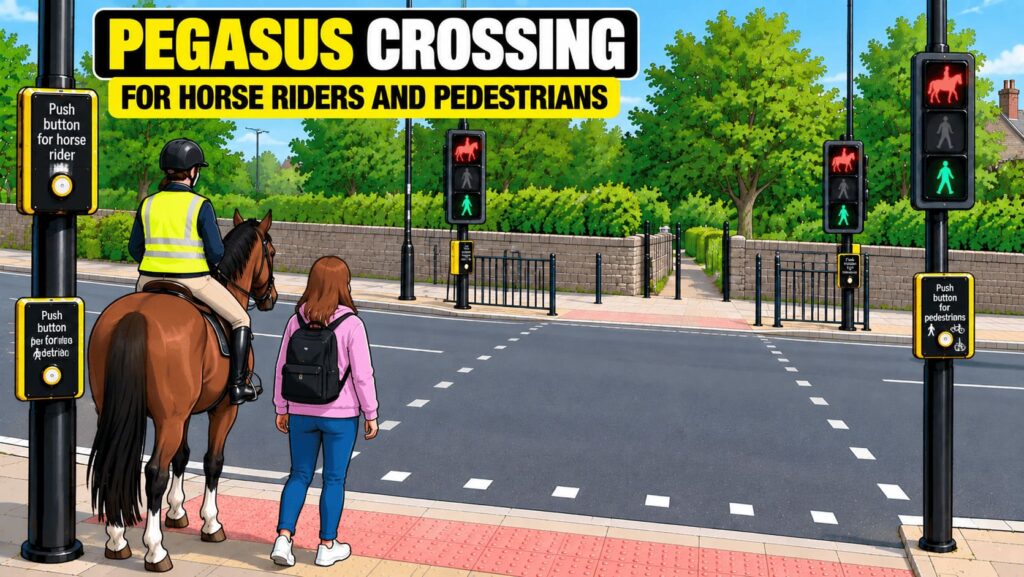
What is a Pegasus crossing?
A Pegasus crossing, also known as an equestrian crossing, is a signal-controlled crossing designed primarily for horse riders. You will often find them where a bridleway or popular horse-riding route crosses a road. They may be positioned alongside a separate pedestrian or toucan crossing.
The easiest way to recognise a Pegasus crossing is by the red and green horse-and-rider symbols rather than just the familiar red and green pedestrian figures. The controls may also be positioned higher than normal, allowing a rider to operate the crossing without having to dismount from their horse.
For drivers, a Pegasus crossing works much like other modern signal-controlled crossings. Red means you must stop, and you must wait for the traffic signal to turn green before proceeding. Unlike a pelican crossing, an equestrian crossing does not have a flashing amber phase; the traffic-light sequence is the same as at ordinary traffic lights.
You should take particular care when approaching one because horses can be frightened by sudden noise or movement. Avoid revving the engine, sounding the horn or accelerating aggressively, and give the horse and rider plenty of space. Even when your light changes to green, you should give way to anyone—including a horse and rider—who is still crossing.
For the theory test, remember the key identification points: Pegasus = horses, look for the horse-and-rider symbols and the higher-mounted control for mounted riders. It is essentially the horse rider’s equivalent of a signal-controlled crossing and is most likely to be encountered where equestrian routes cross busy roads.