adi theory test

Uncategorized

Common Mistakes to Avoid When Taking Free ADI Theory Practice Tests

Common Mistakes to Avoid When Taking Free ADI Theory Practice Tests Preparing for the ADI Part 1 theory test is one of the first major hurdles on the journey to becoming a qualified driving instructor in the UK. Many trainees begin by using free ADI theory practice tests online, which can be a brilliant way to build confidence, improve understanding and identify weak areas before the real exam. One common mistake to avoid when taking free ADI theory practice tests is not familiarizing yourself with the test format. This preparation is crucial for success. However, there’s a problem. A large number of trainees use these practice tests incorrectly. They rush through questions, memorise answers instead of understanding them, or rely on poor-quality revision sites that don’t properly reflect the style and wording used in the real DVSA ADI theory test. The result? People walk into the test centre feeling confident… then leave shocked at how different the real exam felt. The good news is that most of these mistakes are completely avoidable once you understand how to revise properly. In this guide, we’ll break down the most common mistakes trainees make when using free ADI theory practice tests and explain how to avoid them so you can improve your chances of passing first time. Understanding the ADI Theory Test What is the ADI Theory Test? The ADI Part 1 theory test is the first of the three qualifying stages required to become an Approved Driving Instructor in the UK. It is far more advanced than the learner driver theory test and is designed to assess whether potential instructors have the knowledge, understanding and teaching awareness needed to train safe drivers. The test is divided into two parts: The multiple-choice section contains 100 questions split into four separate bands covering subjects such as: To pass, candidates must score at least 85 out of 100 overall and achieve the minimum pass mark in each individual band. The hazard perception section contains 14 video clips designed to test how quickly you can identify developing hazards. Candidates need to score at least 57 out of 75 to pass. This is where many trainees begin to realise the ADI theory test is not simply about memorising facts. It’s about understanding how to apply knowledge in real-world driving and instructional situations. Importance of the ADI Theory Test The ADI theory test is important because it lays the foundation for everything that follows in your instructor training journey. If your knowledge is weak at Part 1 level, it usually shows later during: A good driving instructor needs more than the ability to drive well. They need to: This is why proper preparation matters. Free ADI theory practice tests can be extremely useful tools — but only if they are used correctly. Common Mistakes to Avoid Not Familiarising with the Test Format One of the biggest mistakes trainees make is jumping straight into answering questions without properly understanding how the ADI theory test actually works. Many people revise randomly without learning: This becomes a problem because the ADI theory test is designed to assess understanding, not just recognition. The DVSA often uses: If you are unfamiliar with the structure, you can lose marks simply because the wording catches you out. Before beginning revision, spend time understanding: The more familiar the format becomes, the calmer and more confident you’ll feel on test day. Rushing Through Questions Another very common mistake is reading questions too quickly. Many trainees are “speed readers” without realising it. They skim-read the question, recognise a few familiar words, and instantly click an answer before fully understanding what is being asked. This is dangerous in the ADI Part 1 test because DVSA questions often contain key words such as: Missing just one word can completely change the meaning of the question. For example:A candidate may know the Highway Code well but still answer incorrectly because they failed to notice the question asked for the “best” response rather than a merely “correct” response. It’s essential to recognize these common mistakes to avoid when taking free ADI theory practice tests so you can better prepare for the real thing. Understanding common mistakes to avoid when taking free ADI theory practice tests can enhance your revision strategy significantly. Slow down. Read every question carefully.Then read it again. Many failed attempts happen not because of poor knowledge — but because of poor reading discipline. Ignoring Timed Conditions Some trainees revise in a relaxed environment where they spend unlimited time answering questions. While this can help early understanding, it becomes a problem if they never practise under realistic timed conditions. The real ADI theory test creates pressure. You are: If you have never simulated this environment, your performance can drop significantly on the day. Timed practice helps you: A good strategy is to initially revise without time pressure while learning the topics, then gradually introduce full mock tests under realistic conditions. This prepares both your knowledge and your mindset. Neglecting Official Resources Many candidates rely entirely on random free websites, social media clips or copied questions from unknown sources. Before starting your preparation, remember the common mistakes to avoid when taking free ADI theory practice tests. This is risky. Not all revision materials are accurate or up to date. The ADI theory test is based heavily on official DVSA publications such as: If your revision source does not properly reflect DVSA material, you may end up learning incorrect or outdated information. Good practice tests should: Free tests can be useful — but they should support official study, not replace it. It’s crucial to identify these common mistakes to avoid when taking free ADI theory practice tests to ensure effective study habits. Overlooking Weak Areas A lot of trainees repeatedly revise topics they already feel comfortable with because it feels rewarding. But improvement rarely happens inside your comfort zone. For example: The problem is that the ADI Part 1 test requires balanced performance across all four bands. You cannot compensate for

ADI Part 1 Questions How to Revise the Smart Way In this guide, I’ll walk you through how to revise for ADI Part 1 the right way – not by cramming answers, but by learning the subject. Along the way, I’ll bust the myth that all the DVSA questions are published (they aren’t), and give you tips on how to tackle tricky topics like offside bus lanes and bus gates that catch many people out.
ADI part 1

ADI Theory Test Practice Questions How to Revise the Smart Way (Not Just Memorise)

ADI Theory Test Questions How to Revise the Smart Way ADI THEORY TEST PRACTICE ADI Part 1 Questions How to Revise the Smart Way – So, you’ve set your sights on becoming an Approved Driving Instructor (ADI) and are preparing for the Part 1 Theory Test. Good choice. But as any seasoned ADI will tell you – and any test candidate soon discovers – the ADI Part 1 questions are not your average road sign pop quiz. This is a professional-level theory test, designed to ensure you don’t just know the Highway Code, but that you understand it deeply. ADI Theory Test Practice Part 1 Questions How to Revise the Smart Way ADI Part 1 Questions How to Revise the Smart Way In this guide, I’ll walk you through how to revise for ADI Part 1 the right way – not by cramming answers, but by learning the subject. Along the way, I’ll bust the myth that all the DVSA questions are published (they aren’t), and give you tips on how to tackle tricky topics like offside bus lanes and bus gates that catch many people out. To enhance your learning experience, consider using resources that focus on adi theory test practice, which can help you grasp the concepts more effectively. Incorporating this practice into your study routine can significantly boost your understanding and performance. What is the ADI Part 1 Test? The ADI Part 1 is the first step in your journey to becoming a qualified driving instructor. It’s split into two parts: The pass mark is high: 85/100 overall, with at least 20/25 in each of the four bands. That means you can’t afford to be strong in just one area – you need to be consistently knowledgeable across the board. Why You Can’t Just Memorise ADI Part 1 Questions Here’s the kicker: not all DVSA ADI Part 1 questions are publicly available. That’s right – even the best revision apps and books on the market don’t include every possible question you might face on the day. Many candidates fall into the trap of thinking they can just memorise a bank of questions and breeze through. But when you get hit with a question on something niche – like how to deal with a bus gate on the offside of the road – you’ll wish you’d actually studied the subject instead of just the answers. DVSA intentionally withholds some questions to ensure candidates have truly understood the material, not just rehearsed it. What Are Offside Bus Lanes and Bus Gates? Let’s take a moment to explain why questions like these are important – and tough. You won’t find a simple “What is a bus gate?” question in the test. You might get a scenario with signage or road layout, asking how you should respond. If you’ve just memorised options A, B, and C from a mock test app, you’ll be caught out. 1. Start with the Source: DVSA Publications Use official DVSA material as your primary resource: These books go beyond basic learner driver material. They dig into the why, not just the what – and that’s exactly what you need. BUY YOURS HERE 2. Use a Quality Theory Test Site – But Don’t Stop There Sites like Drivertrainingtheory.co.uk are great for practice. But use them to test your understanding, not to replace it. People often search for “ADI Part 1 mock test free” or “ADI Part 1 practice questions.” Be careful with “free” resources – not all are updated to match the current DVSA standards. 3. Create a Study Plan with Topic-Based Revision Break down your revision into the DVSA’s four key bands: Devote a few days or sessions to each. Focus on understanding, not memorising. If you’re confused about something like bus lanes or rules on emergency vehicles, dig deeper. Use DVSA manuals and government sites, not forums. 4. Watch Real-World Driving Videos YouTube has great content from driving instructors analysing real-world driving scenarios –like Driver Training Theory including bus gates, odd junctions, and city layouts. This helps visual learners and cements how these things appear in the real world, not just in diagrams. 5. Learn to Read Road Signs Like a Pro Instead of memorising the meaning of signs one by one, understand how UK road signs work: Once you grasp that, decoding unfamiliar signs in a test or real-world situation becomes easier. 6. Use Flashcards for Weak Areas Apps like Anki or Quizlet let you create digital flashcards. Focus on tricky topics like: Common Mistakes People Make When Revising for ADI Part 1 🟥 Rote learning only – Fails when unfamiliar questions appear🟥 Ignoring instructional techniques – It’s 25% of your test!🟥 Not reading the question properly – DVSA questions are often scenario-based🟥 Overconfidence from apps – Real test questions are harder and worded differently🟥 Not using official materials – Free doesn’t always mean accurate ADI Part 1 Training – Know the Subject, Not Just the Answer Preparing for the ADI Part 1 test isn’t about beating the system – it’s about proving you understand what it takes to teach others how to drive safely and legally. The DVSA knows when someone’s just memorised a list. That’s why you’ll face questions that are conceptual, scenario-based, or unreleased. It’s also why topics like offside bus lanes or bus gates aren’t just there to trip you up – they test your ability to interpret the road like a professional. So revise smart. Use the right tools, but more importantly – know the why behind every rule, sign, and technique. Because that’s what makes a great instructor. Want more help with your ADI journey?Subscribe to our newsletter for more revision tips, study guides, and insider advice from real ADIs who’ve passed all three parts.

ADI part 1

ADI Theory Test Explained

The ADI Theory Test (Part 1): Everything You Need To Know — And How To Pass With Confidence ADI theory test – Becoming an Approved Driving Instructor isn’t just about handling a car well. It’s about setting standards for others — and that begins with ADI Part 1, the theory stage. Think of this test as the foundation stone. If it’s solid, Parts 2 and 3 feel far more achievable. Below is an expanded breakdown: structure, booking, preparation, scoring, and the pitfalls that quietly catch people out. What exactly does ADI Theory test assess? The DVSA designed Part 1 to check whether you: It mirrors the responsibilities of the job: instructors don’t just pass on information — they shape habits for life. ADI THeory test The two parts of the test — in detail 1️⃣ Multiple-choice questions (100 in total) You’ll answer questions from four “bands”: Band Focus Why it matters 1. Road procedures Rules of the road, safe positioning, priorities You’ll be explaining these daily 2. Signs, control & pedestrians Signs, signals, vehicle handling, vulnerable road users Critical for beginner safety 3. Law & the driving test Legal responsibilities, insurance, disabilities, the test Instructors must advise correctly 4. Instructor skills Teaching methods, learning styles, communication Unique to ADI candidates Pass threshold (multiple-choice) This prevents gaps. Someone brilliant in road law but weak in teaching principles shouldn’t yet be teaching — and the DVSA is right to insist on balance. 2️⃣ Hazard perception (14 clips) You’ll watch real-world scenarios from the driver’s perspective. Your job? Spot developing hazards early — the moment something begins to change and forces you to adjust speed or position. Typical hazards include: The earlier you click, the more you score. Pass threshold (hazard perception) Important note: over-clicking reduces your score. The DVSA system detects “gaming” behaviour. Calm anticipation beats frantic button-tapping every time. How to book the ADI theory test Fees are modest compared to the later stages — but failing repeatedly soon adds up, so preparation still matters. ADI Theory Test What does it cost? The ADI theory test fee is typically £81 (DVSA standard price).(If fees change in the future, the principle remains: good prep is cheaper than retakes.) How long does the test take? Expect to be at the centre roughly two hours. ADI Theory Test On the day — what actually happens There’s no long wait. You’ll know straight away whether you’re moving forward. If you fail — what happens next? You can rebook, but there’s a cooling-off period. More importantly: Remember: once you pass Part 1, a two-year clock starts ticking to pass Parts 2 and 3. Passing solidly (not scraping through) gives you breathing room. The best way to revise — properly 1. Build understanding, not memory tricks Questions often test the principle behind a rule. If you know why, you’ll answer confidently. 2. Train your eyes for hazard perception Watch clips regularly. Narrate the road in your head: “Pedestrian ahead near crossing… car edging… van blocking sightline…” This is exactly what great instructors do when they demonstrate. 3. Space your learning Short daily sessions beat marathon cramming. Give knowledge time to settle. 4. Use mock tests like real exams Sit them without pausing, without checking answers — then review honestly. 5. Track your weak bands If Band 4 (teaching principles) keeps dipping, study teaching techniques specifically, not road signs again. Topics candidates often struggle with These are deeper than “what does this sign mean?” — and rightly so. Frequently asked questions ❓ Do I need special ADI study materials? Yes — ADI-level materials cover teaching topics missing from standard theory books. ❓ Does hazard perception get harder for ADIs? It’s judged more strictly — the expectation is earlier anticipation. ❓ Can I review flagged questions? Yes — you can revisit questions before submitting your multiple-choice section. ❓ Do previous theory passes help? No — everyone training as an instructor must pass Part 1 from scratch. ADI Theory take pride in thorough preparation The ADI theory test isn’t simply a hurdle. It’s the moment you begin thinking like a professional instructor. Approach it the traditional way: It’s the same attitude you’ll one day pass on to your learners — and that continuity is what keeps standards on British roads as strong as they are.

ADI part 1, Driving Theory Test Help ADvice and Training, Hazard Perception Training, LGV Theory Test, Motorcycle Theory Test, PCV Theory Test

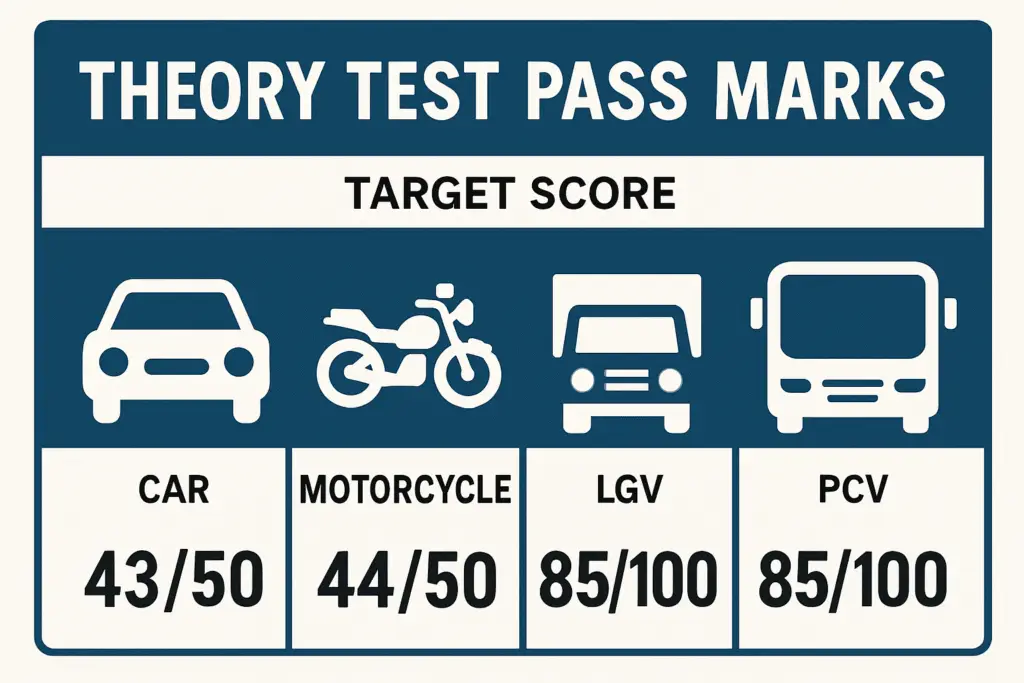
Theory Test Pass Marks Explained

Before you even turn a key or twist a throttle, every British driver faces the same rite of passage — the theory test. It’s the first real test of your road knowledge and hazard perception, and it’s designed to make sure you’re safe, aware, and ready for the realities of driving so what are the theory test pass marks?

Scroll to Top