What is a Puffin Crossing?
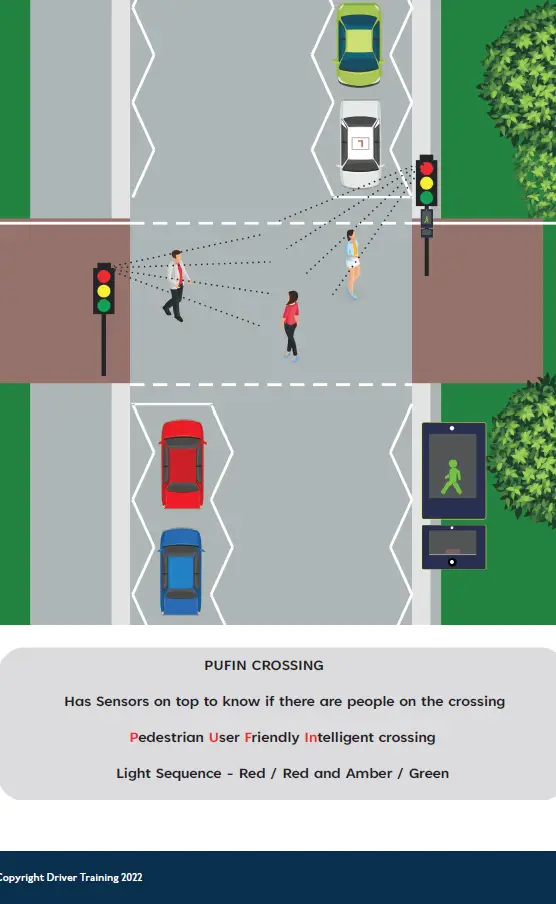
- Definition of what is a Puffin Crossing: A Puffin crossing is a type of pedestrian crossing equipped with sensors that detect pedestrians and control traffic lights for safety and efficiency.
- How Puffin Crossings Work: Sensors detect waiting pedestrians and continuing crossing, keeping traffic red until pedestrians finish crossing, and adjust the lights accordingly.
- Differences from Pelican Crossings: Unlike Pelican crossings, Puffins do not have a flashing amber light phase and feature pedestrian signals at eye level on the near side of the road.
- Puffin Crossings on the Theory Test: Questions may focus on the sensor-based control system of Puffin crossings and the placement of pedestrian signals at eye level.
- Summary of Puffin Crossing Features: Puffin crossings are intelligent, sensor-controlled pedestrian crossings that prioritize pedestrians and operate without a flashing amber phase, making them more polite and safe.
what is a Puffin Crossing
A Puffin crossing (Pedestrian User-Friendly Intelligent crossing) is a type of pedestrian crossing that’s fitted with sensors to make it safer and more efficient. They are designed with the intention of improving pedestrian safety, reducing wait times, and enhancing the overall flow of traffic in busy urban areas.
Here’s how it works:
- Pedestrian sensors above the crossing detect when someone is waiting.
- On-crossing sensors check if people are still crossing the road.
- The traffic lights stay red for vehicles until pedestrians have finished crossing.
- If the pedestrian walks away or crosses quickly, the lights will change back to green for traffic sooner.
what is a Puffin Crossing
Unlike a Pelican crossing:
For instance, in busy urban areas, the implementation of Puffin crossings has led to smoother traffic flow compared to traditional crossings, where pedestrians often faced longer wait times.
- Puffins don’t have a flashing amber light phase for drivers.
- Instead, they go straight from red → amber → green (like normal traffic lights).
- The pedestrian signals (red/green man) are positioned at eye level, on the near side of the road, rather than across the road.
what is a Puffin Crossing On the Theory Test
The DVSA might ask things like:
- “What’s different about a Puffin crossing compared with a Pelican crossing?”
(Answer: Sensors control the lights and there’s no flashing amber phase.) - “Where will you see the pedestrian signal lights at a Puffin crossing?”
(Answer: On your side of the road, at eye level.)
When I explain this to learners, I say:
“A Puffin is smart. It knows when people are crossing, and it holds the red light for cars until they’re clear. Think of it as a polite crossing that looks after pedestrians.”
These crossings also incorporate innovative technology, including timers that display how long pedestrians have to wait, providing additional reassurance and clarity.
Furthermore, the sensors used in Puffin crossings are designed to be highly sensitive and reliable, ensuring that all pedestrians are detected, including those with mobility issues.
What are the key advantages of Puffin Crossings?
Puffin crossings are intelligent, sensor-controlled pedestrian crossings that prioritize pedestrians and operate smoothly without a flashing amber phase, making crossings safer and more polite.
What features of Puffin Crossings are important for the theory test?
The theory test may focus on how the sensors control the traffic lights and the placement of pedestrian signals at eye level on the near side of the road.
What differentiates Puffin Crossings from Pelican Crossings?
Unlike Pelican crossings, Puffin crossings do not have a flashing amber light phase, and pedestrian signals are positioned at eye level on the near side of the road.
How do Puffin Crossings operate?
Puffin crossings use sensors to detect waiting pedestrians and whether they are still crossing, keeping traffic lights red until crossing is complete, and adjusting the signals accordingly.
What is a Puffin Crossing?
A Puffin crossing is a type of pedestrian crossing equipped with sensors that detect pedestrians and control traffic lights for safety and efficiency.
For example, studies have shown that the introduction of Puffin crossings in various locations has resulted in a significant decrease in accidents involving pedestrians, highlighting their effectiveness.
In addition to enhancing safety, Puffin crossings also contribute to the overall efficiency of urban traffic systems, reducing congestion and improving the experience for both pedestrians and drivers.
As cities evolve and pedestrian traffic increases, these crossings are becoming an integral part of urban planning, ensuring that pedestrian needs are met effectively.
What Is a PUFFIN crossing?
In conclusion, the advancements represented by Puffin crossings reflect a broader commitment to enhancing road safety and accommodating the needs of all road users, particularly vulnerable pedestrians.
It’s important to educate drivers about the distinctions between Puffin and other types of crossings, as misunderstanding these differences can lead to dangerous situations.
Therefore, public awareness campaigns are often implemented alongside the introduction of new Puffin crossings to ensure that both drivers and pedestrians understand how to use them safely.