What Is Thinking Distance?
Answer
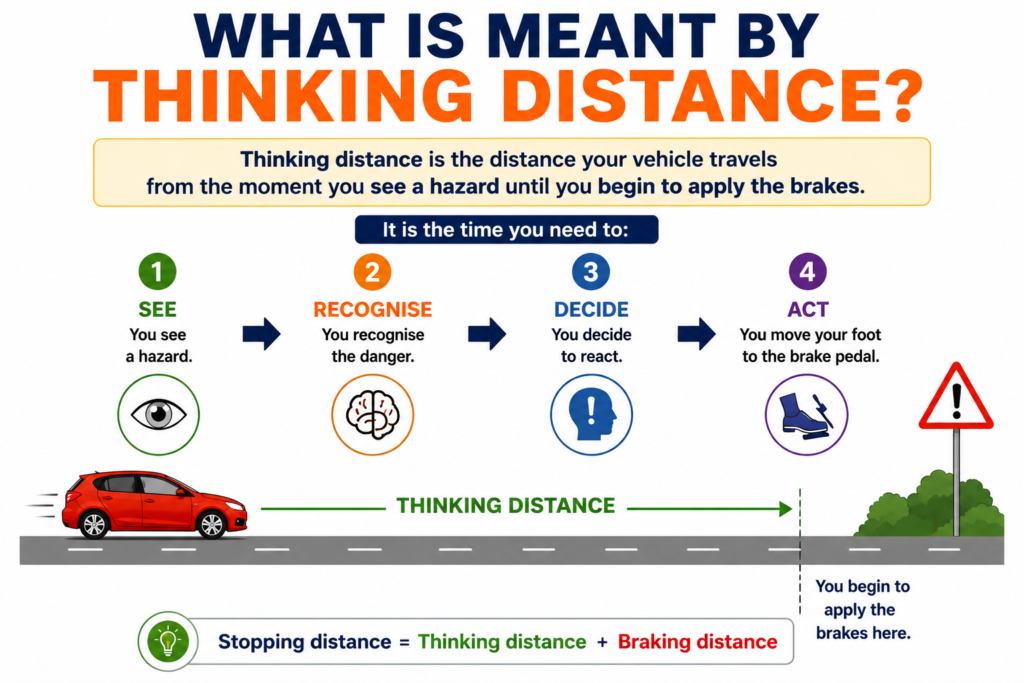
Thinking distance is the distance a vehicle travels between the driver seeing a hazard and applying the brakes.
The concept of what is thinking distance is often misunderstood.
To clarify, what is thinking distance plays a vital role in road safety.
In simple terms, it is the distance travelled while you are thinking and reacting.
SEE OUR FULL GUIDE TO STOPPING DISTANCES
Understanding what is thinking distance can help drivers make safer decisions.
How Does Thinking Distance Work?
Understanding thinking distance is crucial for all drivers, especially in emergency situations. For instance, if a pedestrian suddenly steps onto the road or a vehicle in front of you suddenly brakes, the time it takes for you to assess the situation can significantly impact whether you avoid a collision or not. Research indicates that on average, a driver takes approximately 0.75 seconds to react, translating into substantial distance travelled at high speeds, highlighting the importance of maintaining safe following distances.
When a hazard appears, your brain must:
- See the hazard
- Recognise the danger
- Decide what to do
- Move your foot to the brake pedal
During this time, the vehicle continues moving.
This distance is known as the thinking distance.
The definition of what is thinking distance is essential for new drivers.
Example
To understand what is thinking distance, consider various driving scenarios.
Imagine a child runs into the road ahead.
You do not stop instantly.
In emergencies, what is thinking distance becomes even more critical.
First, you must:
- Notice the child
- Decide to brake
- Move your foot onto the brake pedal
In real-life scenarios, thinking distance can be influenced by various factors, such as the driver’s level of distraction. For example, if a driver is engaged in a conversation on the phone or adjusting the radio, their reaction time can be significantly delayed. This delay can mean the difference between a safe stop and an accident. It is essential for drivers to minimise distractions and keep their focus on the road to reduce thinking distance.
In summary, what is thinking distance should be a key focus for drivers.
During those few moments, the vehicle keeps travelling.
Thinking Distances in the Highway Code
| Speed | Thinking Distance |
|---|---|
| 20 mph | 6 metres |
| 30 mph | 9 metres |
| 40 mph | 12 metres |
| 50 mph | 15 metres |
| 60 mph | 18 metres |
| 70 mph | 21 metres |
As speed increases, thinking distance increases.
Different speeds affect what is thinking distance significantly.
Knowing what is thinking distance can help maintain safe distances.
Why Is Thinking Distance Important?
Thinking distance is important because no driver can react instantly.
Even an alert driver needs time to:
- Observe
- Assess
- Decide
- React
To further illustrate, a driver travelling at 50 mph can cover approximately 22.5 metres in just 1 second. This means that at this speed, the vehicle will travel a significant distance during the time it takes for the driver to perceive a hazard and begin braking. Understanding these distances emphasises the need for drivers to adjust their speed according to road conditions and to maintain a safe stopping distance between themselves and the vehicle in front.
The faster you travel, the further you will travel before braking begins.
Moreover, thinking distance varies depending on the driver’s physical and mental state. For example, fatigue can impair reaction times, making it crucial for drivers to take regular breaks during long journeys. Conditions such as poor visibility due to weather or nighttime driving can also affect how quickly a driver can respond to hazards, thereby increasing thinking distance. Recognising these factors can help drivers adjust their behaviour to ensure they maintain safe distances from potential hazards.
Overall, what is thinking distance impacts your driving safety.
Theory Test Question
What is thinking distance?
To conclude, what is thinking distance must be understood by all drivers.
A) The distance travelled after braking
B) The distance travelled while reacting to a hazard ✅
C) The distance between two vehicles
D) The distance travelled in first gear
Explanation
When reacting to hazards, what is thinking distance is crucial.
Thinking distance is the distance travelled between seeing a hazard and applying the brakes.
Understanding the comprehensive implications of thinking distance is key to responsible driving. Not only does it enhance the driver’s ability to prevent accidents, but it also fosters a broader culture of safety on the roads. Every driver has a responsibility to educate themselves and others about the factors that contribute to safe driving and the importance of managing thinking distance effectively.
Frequently Asked Questions
What is thinking distance?
The distance a vehicle travels between seeing a hazard and applying the brakes.
Does thinking distance increase with speed?
Comprehending what is thinking distance will enhance your driving skills.
Yes. The faster you travel, the further you travel before braking begins.
Is thinking distance the same as braking distance?
No. Thinking distance happens before the brakes are applied. Braking distance happens after the brakes are applied.
Is thinking distance part of the stopping distance?
In conclusion, the concept of thinking distance is a vital aspect of road safety that every driver must understand. It is not merely a statistic but a real factor that affects life and death on the roads. Drivers must educate themselves about their own thinking distances and work actively to reduce them by staying focused, avoiding distractions, and understanding how speed influences stopping distances. This knowledge will empower drivers to make better decisions behind the wheel and promote safer driving habits across the board.
Yes. Thinking distance and braking distance together make up the total stopping distance.
When considering thinking distance, it’s also important to be aware of the role of vehicle safety features. Modern cars often come equipped with advanced braking systems and collision detection technology that can assist in reducing stopping distances. However, these features should not replace the fundamental need for drivers to remain vigilant and aware of their surroundings, as reliance solely on technology can lead to complacency.
Drivers must remember what is thinking distance when assessing risks.
Summary
Thinking distance is the distance travelled between seeing a hazard and pressing the brake pedal. It forms the first part of the total stopping distance and increases as speed increases. Understanding thinking distance helps drivers appreciate why they cannot stop instantly, even when they react quickly. Ultimately, grasping the intricacies of thinking distance is essential for all road users, ensuring a safer driving environment for everyone. By being aware of factors like speed, distractions, and vehicle safety technologies, drivers can significantly enhance their road safety awareness.
Understanding what is thinking distance is vital for safe driving practices.