
On this page
ToggleWhat is the stopping Distance at 70 mph?
Stopping Distances Explained (Ultimate Guide)
What Is a Stopping Distance?
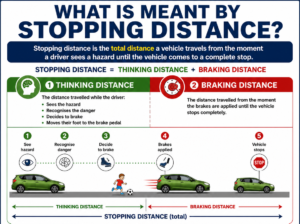
A stopping distance is the total distance a vehicle travels from the moment a driver notices a hazard until the vehicle comes to a complete stop.
Stopping distance is one of the most important topics in the UK Theory Test because it affects every journey you make. Whether you are driving in town, on country roads, dual carriageways, or motorways, understanding stopping distances can help you drive more safely and avoid collisions.
The total stopping distance is made up of two separate parts:
- Thinking Distance
- Braking Distance
When combined, these create the total stopping distance.
Formula
Thinking Distance + Braking Distance = Total Stopping Distance
What Is Thinking Distance?
Thinking distance is the distance travelled while the driver reacts to a hazard.
When a hazard appears, your brain must:
- See the hazard
- Recognise the danger
- Decide what action to take
- Move your foot to the brake pedal
During this time, the vehicle continues moving.
Example
Imagine a child runs into the road ahead.
Before you even touch the brake pedal, your vehicle may have already travelled several metres.
At 30 mph, the average thinking distance is:
9 metres
At 70 mph, the average thinking distance is:
21 metres
The faster you travel, the further you travel during your reaction time.
What Is Braking Distance?
Braking distance is the distance travelled after the brakes have been applied until the vehicle comes to a complete stop.
Braking distance depends on several factors, including:
- Speed
- Road surface
- Tyre condition
- Brake condition
- Vehicle load
- Weather conditions
Braking distance increases dramatically as speed increases.
For example:
| Speed | Braking Distance |
|---|---|
| 20 mph | 6 metres |
| 30 mph | 14 metres |
| 40 mph | 24 metres |
| 50 mph | 38 metres |
| 60 mph | 55 metres |
| 70 mph | 75 metres |
Notice how braking distance rises much faster than speed.
UK Highway Code Stopping Distances
The Highway Code provides the following typical stopping distances for cars in good conditions.
| Speed | Thinking Distance | Braking Distance | Total Stopping Distance |
|---|---|---|---|
| 20 mph | 6 metres | 6 metres | 12 metres |
| 30 mph | 9 metres | 14 metres | 23 metres |
| 40 mph | 12 metres | 24 metres | 36 metres |
| 50 mph | 15 metres | 38 metres | 53 metres |
| 60 mph | 18 metres | 55 metres | 73 metres |
| 70 mph | 21 metres | 75 metres | 96 metres |
These figures are based on:
- A dry road
- Good tyres
- Good brakes
- An alert driver
Real-world stopping distances are often much longer.
Why Do Stopping Distances Increase So Quickly?
Many learner drivers assume that doubling speed doubles stopping distance.
It does not.
Let’s compare:
| Speed | Total Stopping Distance |
|---|---|
| 30 mph | 23 metres |
| 60 mph | 73 metres |
Although the speed has doubled, the stopping distance has more than tripled.
This happens because a vehicle travelling faster has much more kinetic energy. The brakes must work harder and over a greater distance to bring the vehicle to a stop.
This is one reason why speeding significantly increases collision risk.
What Can Increase Thinking Distance?
Thinking distance can increase whenever a driver’s reaction time becomes slower.
Common causes include:
Tiredness
Fatigue reduces concentration and slows reactions.
Alcohol
Even small amounts of alcohol can affect judgement and reaction times.
Drugs
Both illegal drugs and some prescribed medications can impair reactions.
Mobile Phones
Using a phone while driving can distract a driver from hazards.
Distractions
Examples include:
- Adjusting the radio
- Using a sat-nav
- Eating or drinking
- Talking to passengers
Poor Concentration
Stress, illness, and lack of attention can all increase thinking distance.
What Can Increase Braking Distance?
Braking distance is heavily influenced by grip between the tyres and the road.
Wet Roads
Water reduces grip and can at least double braking distance.
Ice and Snow
Ice dramatically reduces tyre grip.
In icy conditions, stopping distances can be up to ten times greater than normal.
Worn Tyres
Tyres with poor tread cannot grip the road effectively.
Faulty Brakes
Poorly maintained brakes increase stopping distances.
Overloaded Vehicles
Extra weight means more energy must be absorbed during braking.
Downhill Roads
Gravity increases momentum and can extend braking distances.
How Weather Affects Stopping Distance
Weather conditions have a significant impact on road safety.
Rain
In wet weather:
- Grip is reduced
- Braking distance increases
- Risk of skidding rises
Drivers should leave at least double the normal following distance.
Fog
Although fog may not directly increase braking distance, it reduces visibility, meaning hazards are often seen later.
Snow
Snow can significantly increase stopping distances.
Smooth acceleration, steering, and braking are essential.
Ice
Ice creates some of the most dangerous driving conditions.
Stopping distances can be up to ten times longer than normal.
How Tyres Affect Stopping Distance
Tyres are the only part of the vehicle touching the road.
Their condition plays a vital role in stopping safely.
Legal Minimum Tread Depth
The legal minimum tread depth for cars in the UK is:
1.6 mm across the central three-quarters of the tread around the entire circumference.
Why Tread Matters
Good tread helps:
- Remove water from the road surface
- Maintain grip
- Improve braking performance
- Reduce aquaplaning risk
Worn tyres increase braking distances, especially in wet weather.
How Following Distance Relates to Stopping Distance
Understanding stopping distance helps drivers choose a safe following distance.
The Two-Second Rule
In dry conditions:
Choose a fixed object ahead.
When the vehicle in front passes it, begin counting:
“Only a fool breaks the two-second rule.”
If you reach the object before finishing the phrase, you are too close.
In Wet Conditions
Double the gap to:
At least four seconds.
In Ice and Snow
Allow even more space.
Stopping distances can increase dramatically.
Easy Way to Remember Stopping Distances
Many learner drivers struggle to memorise stopping distances.
The best approach is repeated practice.
Remember the Highway Code figures:
| Speed | Total Stopping Distance |
|---|---|
| 20 mph | 12 metres |
| 30 mph | 23 metres |
| 40 mph | 36 metres |
| 50 mph | 53 metres |
| 60 mph | 73 metres |
| 70 mph | 96 metres |
Regular testing and revision usually work better than memorisation tricks.
Common Theory Test Questions About Stopping Distances
What Is the Stopping Distance at 30 mph?
23 metres.
What Is the Stopping Distance at 70 mph?
96 metres.
What Is Thinking Distance?
The distance travelled before the brakes are applied.
What Is Braking Distance?
The distance travelled after the brakes are applied until the vehicle stops.
What Increases Thinking Distance?
Tiredness, alcohol, drugs, distractions, and poor concentration.
What Increases Braking Distance?
Wet roads, ice, snow, worn tyres, faulty brakes, and overloaded vehicles.
Why Is Stopping Distance Important?
It helps drivers maintain safe following distances and avoid collisions.
Frequently Asked Questions
Do stopping distances appear in the Theory Test?
Yes. Stopping distances are one of the most common topics in the UK Theory Test and ADI Part 1 examination.
Are stopping distances exact?
No. They are typical Highway Code figures based on ideal conditions.
Does rain affect stopping distance?
Yes. Wet roads reduce grip and increase braking distances.
Does speed affect stopping distance?
Yes. As speed increases, stopping distances increase dramatically.
Can poor tyres increase stopping distance?
Yes. Worn tyres reduce grip and increase braking distances, particularly on wet roads.
What is the difference between thinking distance and braking distance?
Thinking distance occurs before braking begins. Braking distance occurs after the brakes are applied.
What is the stopping distance at 50 mph?
53 metres.
What is the stopping distance at 60 mph?
73 metres.
What is the stopping distance at 70 mph?
96 metres.
Why should learner drivers know stopping distances?
Understanding stopping distances helps drivers judge safe speeds, maintain safe following distances, and respond effectively to hazards.
Final Thoughts
Stopping distances are a fundamental part of safe driving. Every time you drive, your ability to recognise hazards, react quickly, and stop safely depends on understanding the relationship between thinking distance, braking distance, and total stopping distance.
Whether you are preparing for your Theory Test, practical driving test, or ADI Part 1 examination, learning the Highway Code stopping distances and understanding the factors that affect them will make you a safer and more confident driver.
Understanding stopping distance is crucial for safe driving.
Many factors influence stopping distance, including speed and road conditions.
Always remember that your stopping distance will vary based on your vehicle’s speed.
In emergency situations, knowing your stopping distance can save lives.
A driver’s awareness of stopping distance can greatly improve road safety.
Adjust your speed according to the required stopping distance for your safety.
Regularly reviewing your understanding of stopping distance can enhance driving skills.
Driving within the limits of your stopping distance is essential in adverse weather conditions.
Consideration of stopping distance is vital when approaching traffic signals.
Always account for stopping distance when driving with a full load.