What Is Braking Distance? (UK Theory Test Guide)
Understanding What Is Braking Distance
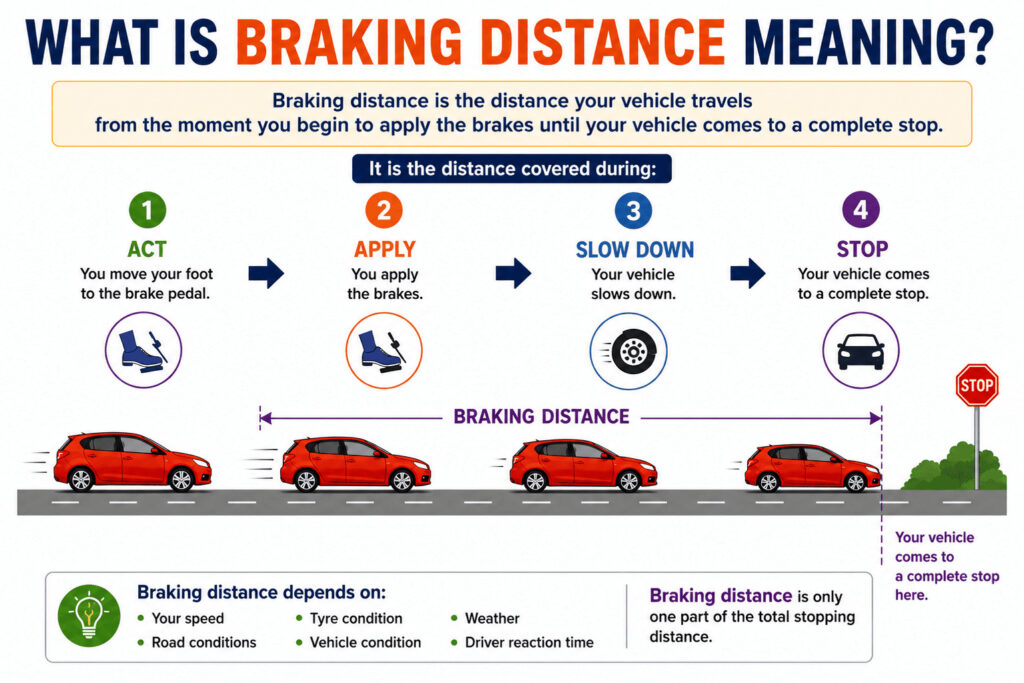
Braking distance is the distance a vehicle travels from the moment the brakes are applied until the vehicle comes to a complete stop.
It is one part of the overall stopping distance, which consists of:
When discussing what is braking distance, it is important to understand the context of stopping distances.
- Thinking Distance – the distance travelled while reacting to a hazard.
- Braking Distance – the distance travelled after the brakes are applied.
Formula:
Stopping Distance = Thinking Distance + Braking Distance
For example, at 30 mph:
- Thinking Distance: 9 metres
- Braking Distance: 14 metres
- Total Stopping Distance: 23 metres
This is based on the figures in the UK Highway Code.
Why Is Braking Distance Important?
Understanding braking distance is essential for both the UK Theory Test and safe driving.
Many drivers underestimate how far a vehicle travels after the brakes are applied. Even modern vehicles cannot stop instantly.
If you leave insufficient space between your vehicle and the one ahead, you may not have enough room to stop safely if traffic suddenly slows down.
Highway Code Braking Distances
Knowing what is braking distance can help you prevent accidents.
| Speed | Braking Distance |
| 20 mph | 6 metres |
| 30 mph | 14 metres |
| 40 mph | 24 metres |
| 50 mph | 38 metres |
| 60 mph | 55 metres |
| 70 mph | 75 metres |
Understanding what is braking distance is vital for road safety.
Grasping the concept of what is braking distance aids in safe driving practices.
What is braking distance? It is crucial for assessing your stopping capabilities.
To summarise what is braking distance: it is the distance needed after brakes are applied.
In your learning, remember what is braking distance as a key concept.
Knowing what is braking distance can save lives on the road.
Every driver should understand what is braking distance for effective risk management.
Notice that when speed doubles, braking distance increases dramatically.
At 70 mph, your braking distance is more than five times greater than at 30 mph.
What Affects Braking Distance?
Several factors can increase braking distance.
Speed
The faster you travel, the longer it takes to stop.
A small increase in speed can create a much larger increase in braking distance.
Wet Roads
Wet surfaces reduce tyre grip.
The Highway Code recommends allowing at least double the normal stopping distance in wet conditions.
Ice and Snow
Ice and snow can significantly reduce grip.
Stopping distances can increase by up to ten times compared to dry roads.
To ensure safety, keep in mind what is braking distance while driving.
Worn Tyres
Tyres with poor tread depth cannot grip the road effectively.
This reduces braking performance and increases stopping distances.
Poorly Maintained Brakes
Worn brake pads, discs, or other braking components may reduce braking efficiency.
Regular vehicle maintenance is essential.
Vehicle Weight
A heavily loaded vehicle may take longer to stop than a lightly loaded one.
Extra weight means the brakes have more momentum to overcome.
Braking Distance Example
Imagine you are driving at 50 mph and a child runs into the road.
After you react and apply the brakes:
- The vehicle continues travelling while braking.
- It takes approximately 38 metres to stop after the brakes are applied.
- Combined with your thinking distance, the total stopping distance becomes 53 metres.
This demonstrates why maintaining a safe following distance is vital.
Easy Way to Remember Braking Distance
For the UK Theory Test, remember that braking distances increase rapidly as speed increases.
Many learners focus on thinking distances but forget that braking distance makes up the largest part of the total stopping distance at higher speeds.
The key message is simple:
Higher speed = Much longer braking distance.
Common Theory Test Question
What is braking distance?
Answer:
The distance a vehicle travels from the moment the brakes are applied until the vehicle comes to a complete stop.
Frequently Asked Questions
Is braking distance the same as stopping distance?
No.
Braking distance is only the distance travelled after the brakes are applied.
Stopping distance includes both thinking distance and braking distance.
Does rain affect braking distance?
Yes.
Wet roads reduce grip and can double stopping distances.
What increases braking distance the most?
Speed has the greatest effect on braking distance.
Wet roads, ice, worn tyres, worn brakes, and heavy vehicle loads can also increase it.
Do braking distances appear in the UK Theory Test?
Yes.
Always consider what is braking distance when assessing vehicle performance.
Remember that what is braking distance is affected by various factors.
Ultimately, what is braking distance determines your stopping ability.
For safe driving, reflect on what is braking distance during your journey.
In conclusion, what is braking distance is vital knowledge for every driver.
Understanding braking distances, stopping distances, and factors that affect them is an important part of the UK Theory Test.
What is the braking distance at 70 mph?
According to the Highway Code, the braking distance at 70 mph is 75 metres.
Braking distance is the distance travelled after the brakes are applied until the vehicle stops completely.
The faster you travel, the longer your braking distance becomes. Weather conditions, tyre condition, brake condition, and vehicle weight can all increase braking distance.
Learning these distances is essential for passing the UK Theory Test and becoming a safer driver on Britain’s roads.
Related Guides:
- What Is Thinking Distance?
- What Is Stopping Distance?
- Factors Affecting Stopping Distance
- The 2-Second Rule Explained
- Highway Code Stopping Distances Explained