What Affects Braking Distance?
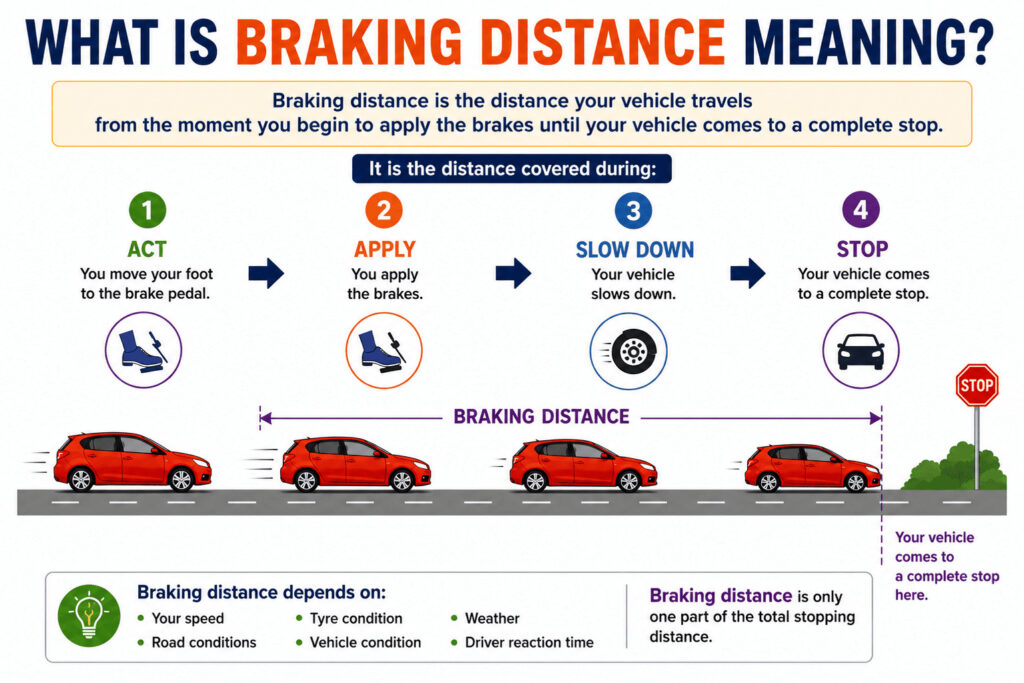
Understanding what affects braking distance is crucial for safe driving.
Braking distance is not fixed. The figures shown in the Highway Code are based on a vehicle in good condition, travelling on a dry road, with properly functioning brakes and tyres.
SEE OUR FULL GUIDE TO STOPPING DISTANCES
Several factors contribute to what affects braking distance.
In the real world, many factors can increase the distance needed to stop once the brakes are applied.
Speed
It is important to know what affects braking distance when driving.
Understanding what affects braking distance helps in preventing accidents.
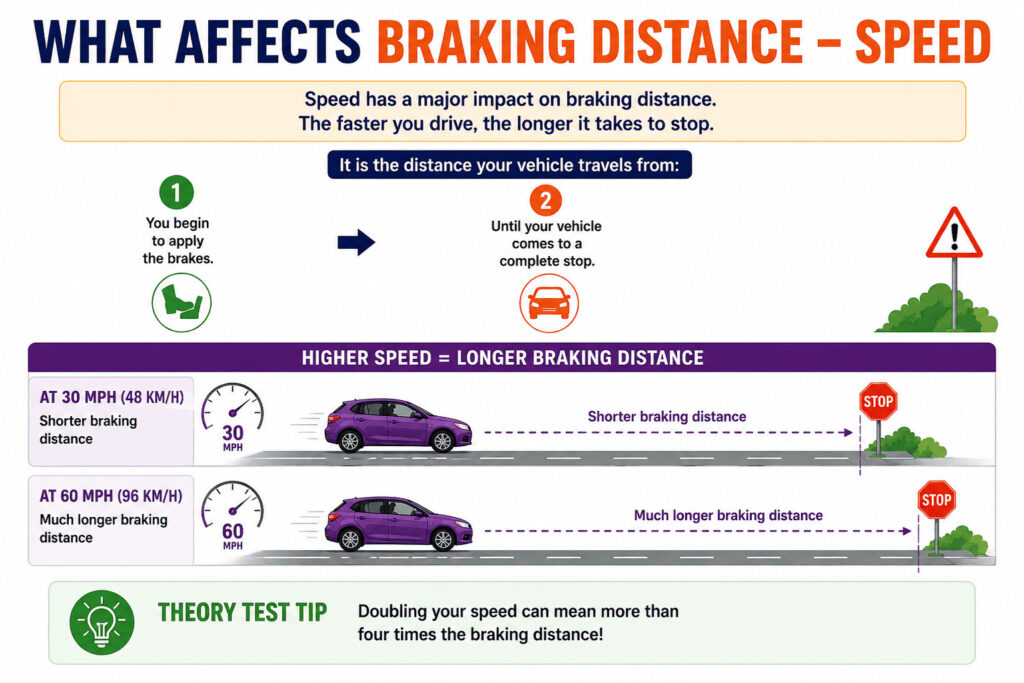
Speed has the greatest effect on braking distance.
Many drivers assume that doubling their speed will double their braking distance. In reality, braking distance increases much more rapidly than this.
This is because a faster-moving vehicle has significantly more momentum and kinetic energy. The brakes must work much harder to slow the vehicle down and bring it to a stop.
What affects braking distance is often underestimated by many drivers.
For example:
| Speed | Braking Distance |
| 20 mph | 6 metres |
| 40 mph | 24 metres |
| 60 mph | 55 metres |
| 70 mph | 75 metres |
Drivers should be mindful of what affects braking distance to ensure safety.
Notice that when speed doubles from 20 mph to 40 mph, the braking distance increases from 6 metres to 24 metres – four times greater.
Knowing what affects braking distance can improve response times.
Environmental conditions are one of the key factors in what affects braking distance.
Being aware of what affects braking distance can reduce stopping time.
This is why even a small increase in speed can have a major impact on stopping distance.
Theory Test Tip
The faster you travel, the more dramatically braking distance increases.
Wet Roads
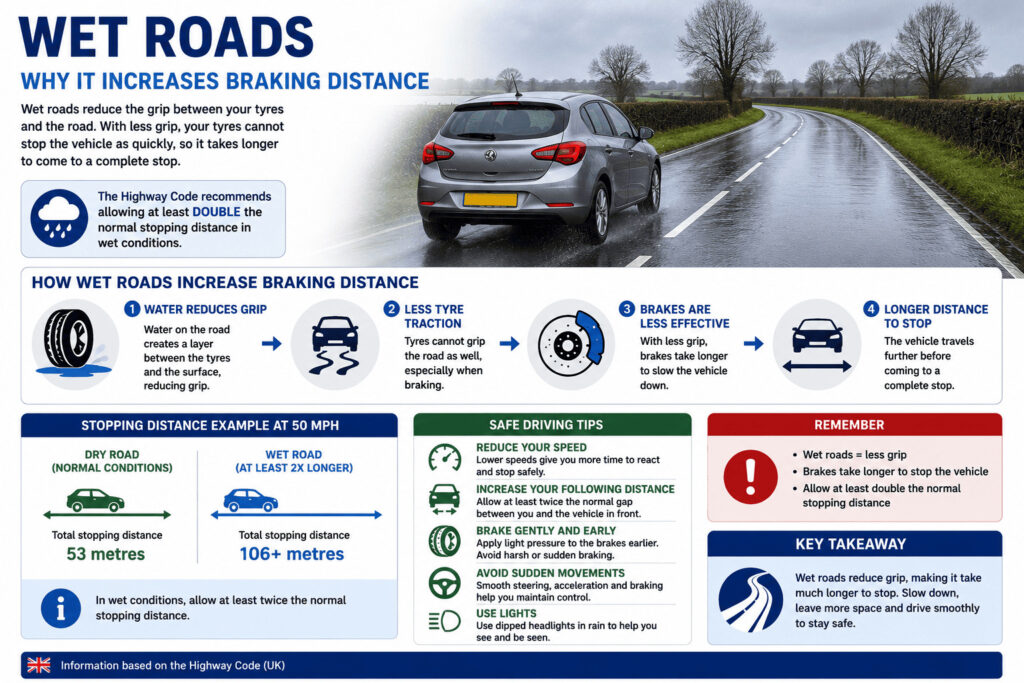
Water reduces the grip between your tyres and the road surface.
To drive safely, understand what affects braking distance in various conditions.
Factors like speed directly relate to what affects braking distance.
Drivers must consider what affects braking distance on different surfaces.
When the road is wet, tyres cannot grip the road as effectively, making it harder for the brakes to slow the vehicle.
What affects braking distance can vary significantly based on vehicle condition.
As a result, the vehicle will continue travelling further before stopping.
The Highway Code advises that in wet weather you should allow at least double the normal stopping distance.
For example:
- Dry road stopping distance at 50 mph = 53 metres
- Wet road stopping distance at 50 mph = approximately 106 metres
This extra space gives you more time to stop safely if a hazard appears.
Theory Test Tip
In wet conditions, allow at least twice the normal stopping distance.
Ice and Snow
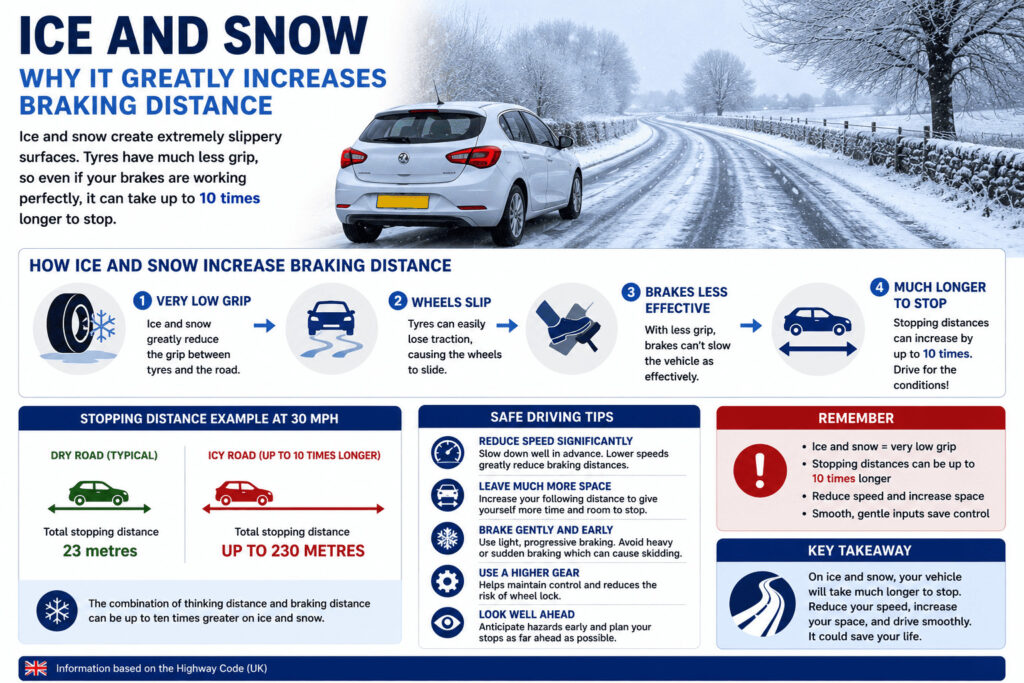
Ice and snow create extremely slippery road surfaces.
Even if your brakes are working perfectly, they can only slow the vehicle if the tyres have grip. On ice, there may be very little grip available.
This means the wheels can easily lose traction, causing the vehicle to slide.
The Highway Code advises that stopping distances can be up to ten times greater on icy roads.
For example:
- Dry road stopping distance at 30 mph = 23 metres
- Icy road stopping distance at 30 mph = up to 230 metres
This is why drivers should reduce speed significantly and leave much larger gaps in winter conditions.
Theory Test Tip
On icy roads, stopping distances can increase by up to ten times.
Worn Tyres
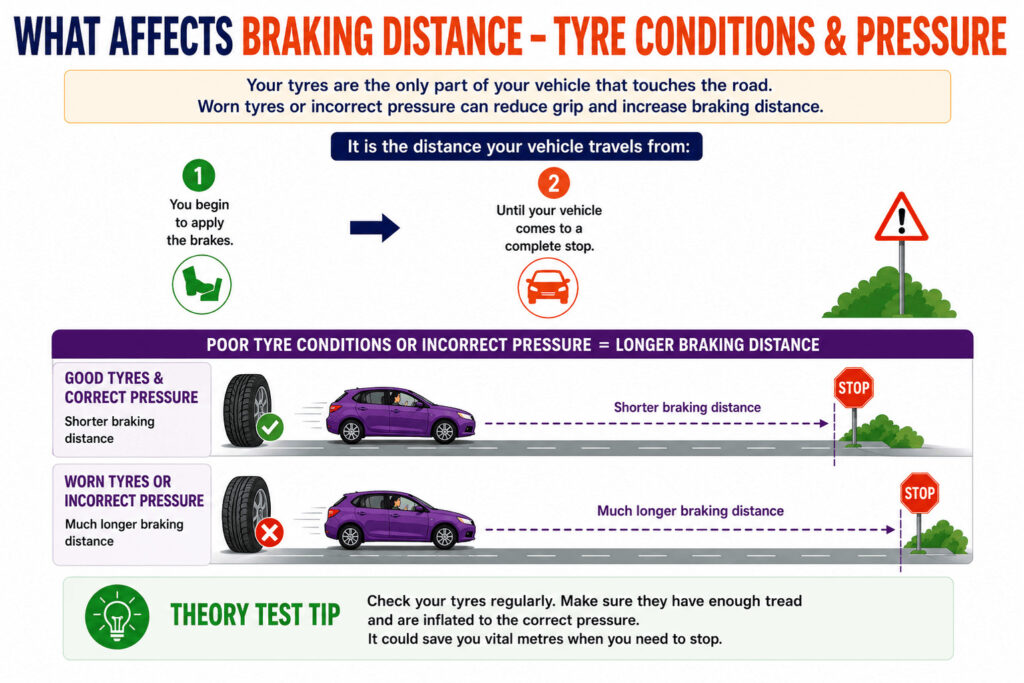
Tyres are the only part of the vehicle that touches the road.
Good tyre tread helps channel water away from the contact patch, allowing the tyre to maintain grip.
When tyres become worn, their ability to grip the road is reduced, especially in wet conditions.
This can lead to:
- Longer braking distances
- Reduced steering control
- Increased risk of skidding
- Greater risk of aquaplaning
The legal minimum tread depth for cars in the UK is 1.6 mm across the central three-quarters of the tyre around its entire circumference.
However, many safety organisations recommend replacing tyres before they reach this limit.
Theory Test Tip
Worn tyres reduce grip and increase braking distances, particularly on wet roads.
Poorly Maintained Brakes
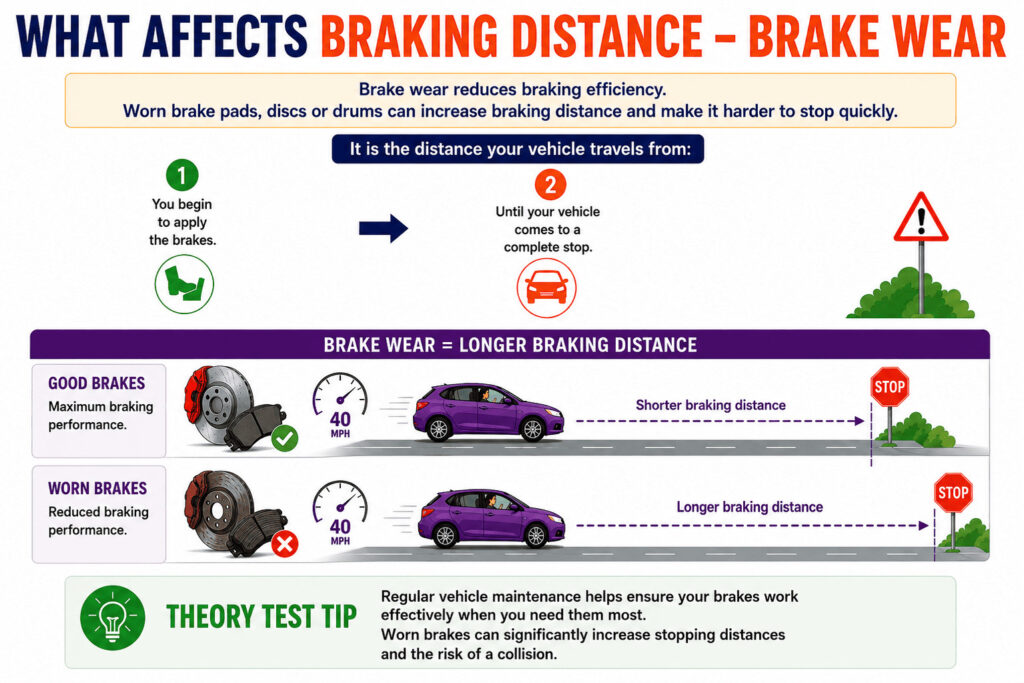
Brakes must be in good condition to stop a vehicle efficiently.
Over time, brake pads, discs, drums and other components wear down through normal use.
If the braking system is not maintained correctly, braking performance may be reduced.
Signs of brake problems include:
- Grinding noises
- Squealing brakes
- Vibrations when braking
- Pulling to one side
- Increased stopping distances
Regular servicing and maintenance help ensure that the braking system works effectively when you need it most.
Theory Test Tip
Faulty or worn brakes can significantly increase braking distance.
Vehicle Weight
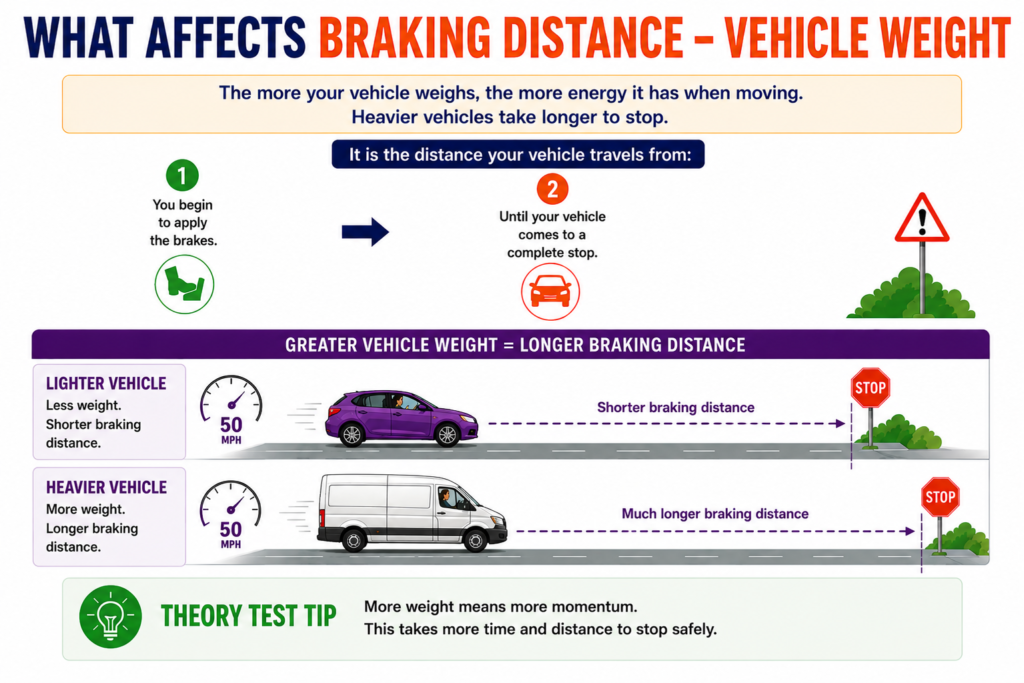
The heavier a vehicle is, the harder it is to stop.
Extra passengers, luggage, tools, equipment or towing a trailer all increase the vehicle’s overall weight.
A heavier vehicle has more momentum, meaning the brakes must work harder to slow it down.
This can result in:
- Longer braking distances
- Increased wear on brakes and tyres
- Reduced acceleration
- Changes to vehicle handling
Drivers should be particularly aware of this when driving heavily loaded vehicles, vans or vehicles towing trailers.
Theory Test Tip
More weight means more momentum, which can increase braking distance.
Road Surface
The condition of the road surface can also affect braking distance.
Surfaces that provide less grip make it harder for tyres to maintain traction.
Examples include:
- Loose gravel
- Mud
- Wet leaves
- Diesel spills
- Oil spills
- Newly painted road markings
- Manhole covers in wet weather
When grip is reduced, the vehicle may take longer to stop and could skid if braking sharply.
Theory Test Tip
Poor road surfaces reduce tyre grip and increase braking distance.
Downhill Slopes
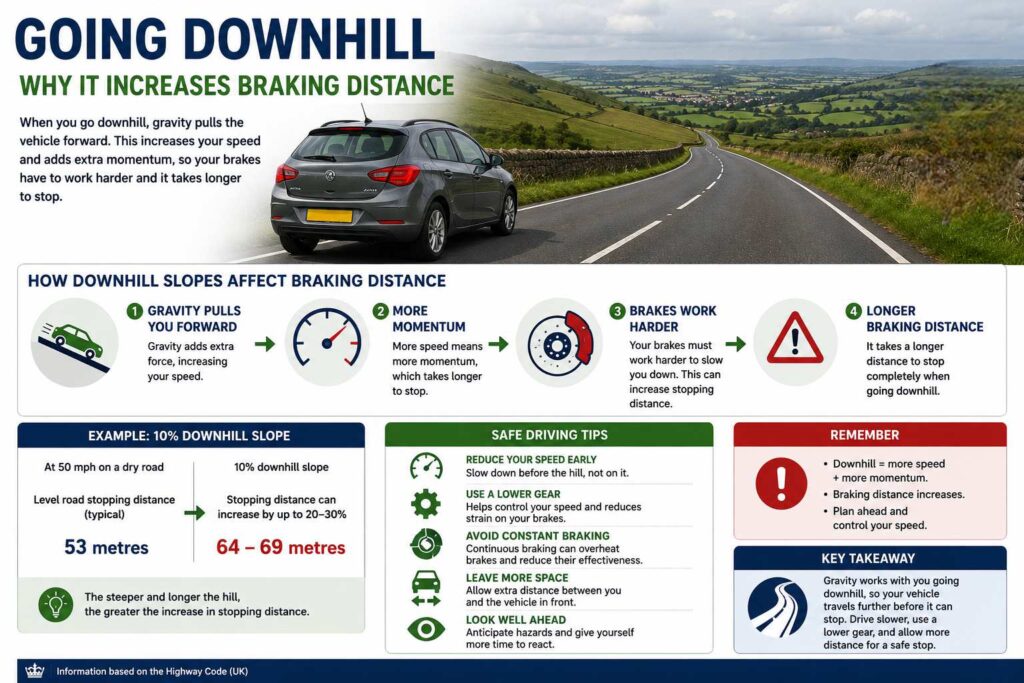
Gravity affects braking distance when travelling downhill.
On a steep descent, the vehicle is naturally being pulled forward by gravity, meaning the brakes must work harder to slow it down.
As a result:
- Braking distances increase
- Brake temperatures rise
- Brake effectiveness may reduce on long descents
Drivers should reduce speed early and use an appropriate gear when travelling downhill.
Theory Test Tip
Vehicles travelling downhill usually need a longer distance to stop.
Key Takeaway
The main factors that increase braking distance are:
- Higher speeds
- Wet roads
- Ice and snow
- Worn tyres
- Poorly maintained brakes
- Heavy vehicle loads
- Slippery road surfaces
- Downhill gradients
Understanding these factors is essential for both the UK Theory Test and safe everyday driving. The less grip available and the more momentum your vehicle has, the longer it will take to stop.
Understanding what affects braking distance can enhance overall road safety.
Ultimately, what affects braking distance is vital knowledge for every driver.
Recognising what affects braking distance should be part of driver education.