Stopping Distances Explained for the UK Theory Test
When preparing for your UK theory test, few topics are as important as stopping distances. They regularly appear in theory test questions, hazard perception discussions, and are essential knowledge for safe driving.
Many learner drivers memorise the figures purely to pass the test. However, understanding what they mean in real-world driving can help keep you, your passengers, and other road users safe.
What Is a Stopping Distance?
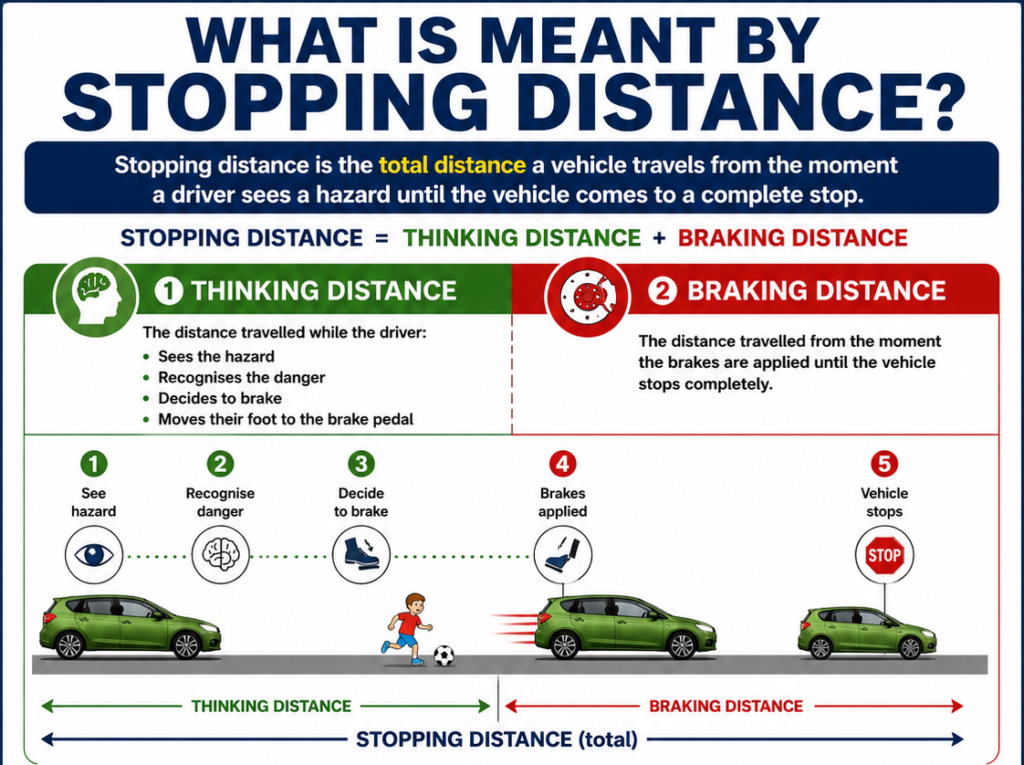
A stopping distance is the total distance your vehicle travels from the moment you spot a hazard to the moment the vehicle comes to a complete stop.
It consists of two parts:
Thinking Distance and braking distance
What is Thinking Distance?
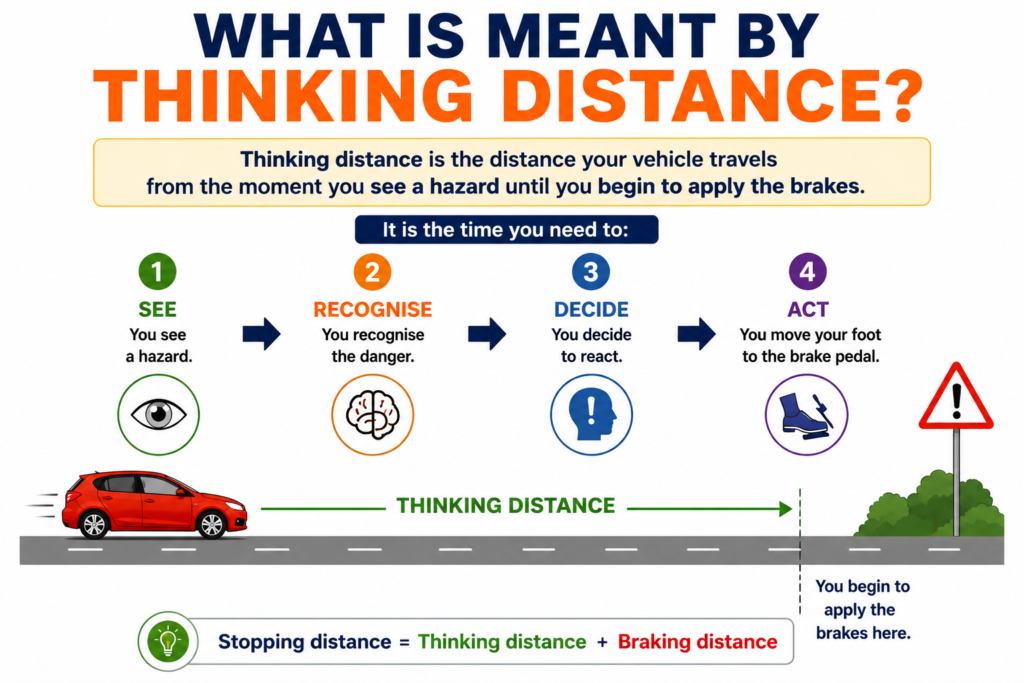
Thinking distance is the distance your vehicle travels from the moment you see a hazard until you begin to apply the brakes.
It includes the time needed to:
- See the hazard
- Recognise the danger
- Decide to react
- Move your foot onto the brake pedal
Stopping Distance = Thinking Distance + Braking Distance
Example at 30 mph – At 30 mph, the Highway Code gives a thinking distance of 9 metres.
This means your car can travel approximately 9 metres before you even start braking.
Thinking distance is the distance travelled while you:
- See the hazard
- Recognise the danger
- Decide to brake
- Move your foot to the brake pedal
Braking Distance
This is the distance travelled after the brakes have been applied until the vehicle stops completely.
Simple Formula
Stopping Distance = Thinking Distance + Braking Distance
The Official Highway Code Stopping Distances
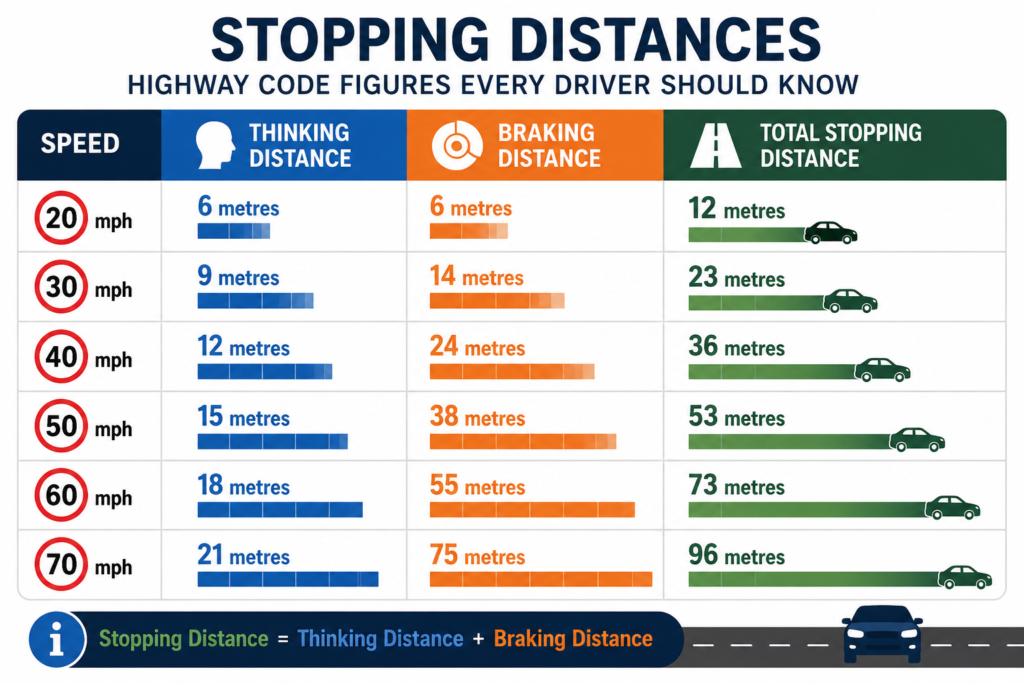
The UK Highway Code provides the following figures, which every learner driver should know for the theory test:
Speed Thinking Distance Braking Distance Total Stopping Distance
20 mph 6 metres 6 metres 12 metres
30 mph 9 metres 14 metres 23 metres
40 mph 12 metres 24 metres 36 metres
50 mph 15 metres 38 metres 53 metres
60 mph 18 metres 55 metres 73 metres
70 mph 21 metres 75 metres 96 metres
Why Stopping Distances Increase So Quickly
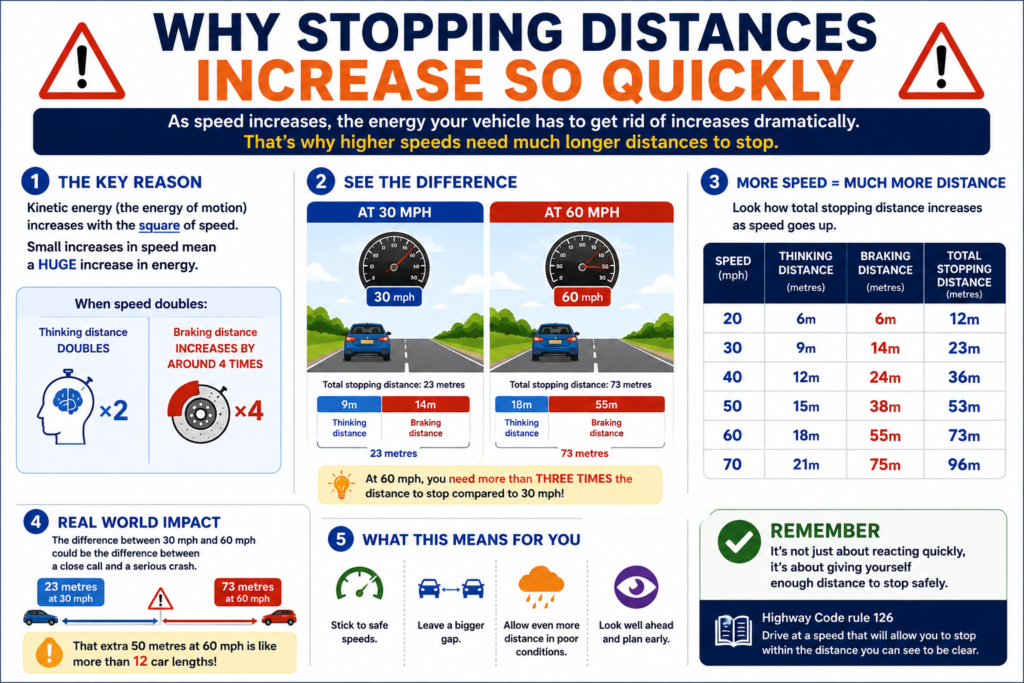
One of the biggest surprises for new drivers is how dramatically stopping distances increase as speed rises.
At 70 mph, you are not travelling just twice as fast as at 35 mph. The energy involved is much greater.
When speed doubles:
- Thinking distance doubles
- Braking distance increases by around four times
This is because the vehicle has much more kinetic energy that must be removed before it can stop.
This is why a small increase in speed can make a huge difference to the distance needed to stop safely.
What Can Increase Thinking Distance?
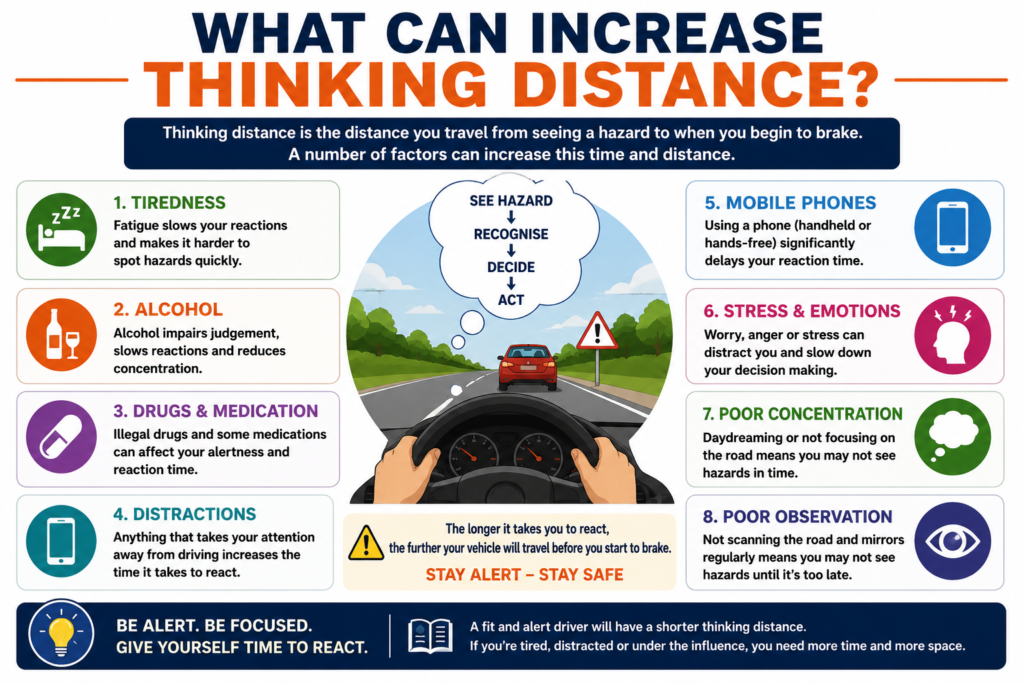
The Highway Code figures assume a fit and alert driver.
In reality, thinking distance can increase due to:
- Tiredness
- Alcohol
- Drugs
- Certain medications
- Distractions
- Using a mobile phone
- Stress
- Poor concentration
A distracted driver may travel many extra metres before even beginning to brake.
What Can Increase Braking Distance?
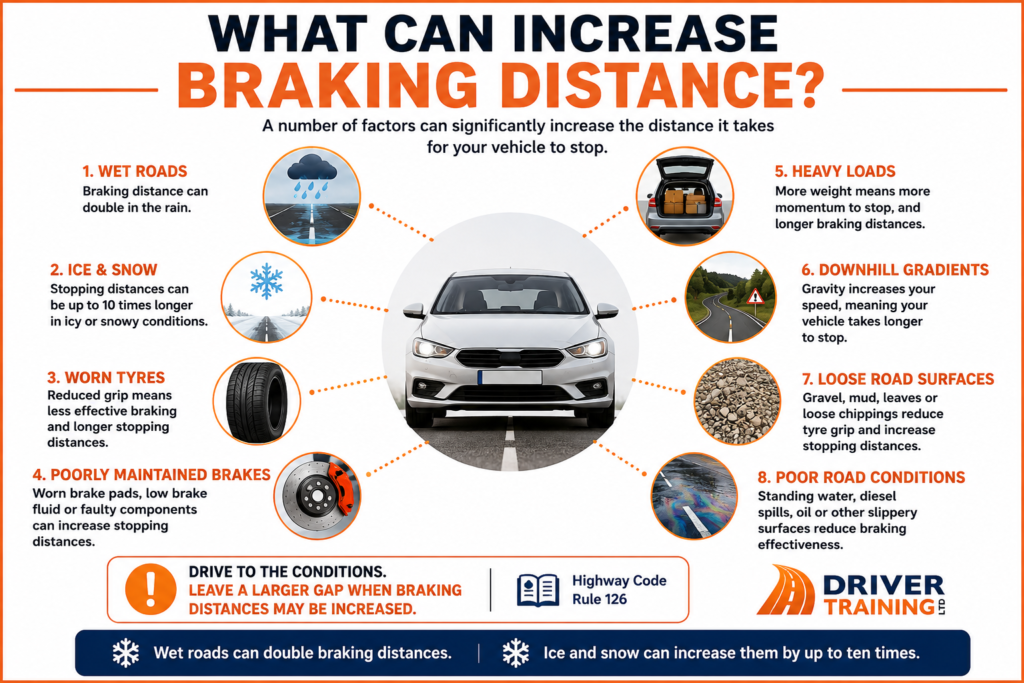
Braking distance can increase significantly because of:
Wet Roads
A wet road can double braking distances.
Ice and Snow
Stopping distances can increase by up to ten times in icy conditions.
Worn Tyres
Poor tyre tread reduces grip and increases stopping distance.
Poor Brakes
Faulty or poorly maintained brakes reduce stopping performance.
Heavy Loads
Extra weight means more momentum and often longer stopping distances.
Downhill Gradients
Gravity helps the vehicle continue moving, increasing stopping distance.
The Two-Second Rule
Rather than trying to estimate stopping distances while driving, the Highway Code recommends the two-second rule.
Choose a fixed object ahead such as:
- A sign
- A bridge
- A lamp post
When the vehicle in front passes it, begin counting:
“Only a fool breaks the two-second rule.”
If you reach the object before finishing the phrase, you are following too closely.
In wet conditions, double the gap to at least four seconds. In icy or snowy conditions, allow even more space.